ARG70127
Click to copy
Human FGF21 recombinant protein (Active) (His-tagged, C-ter)
Human FGF21 recombinant protein (Active) (His-tagged, C-ter) for SDS-PAGE
Overview
| Product Description | E. coli expressed, His-tagged (C-ter) Active Human FGF21 recombinant protein |
|---|---|
| Tested Application | SDS-PAGE |
| Target Name | FGF21 |
| Species | Human |
| A.A. Sequence | His29 - Ser209 |
| Expression System | E. coli |
| Activity | Active |
| Activity Note | Determined by its ability to induce proliferation in BaF3 cells transfected with human FGFRIIIc. The ED50 for this effect is < 0.4 μg/mL. |
| Alternate Names | Fibroblast growth factor 21; FGF-21 |
Properties
| Form | Powder |
|---|---|
| Purification Note | Endotoxin level is less than 0.1 EU/µg of the protein, as determined by the LAL test. |
| Purity | > 98% (by SDS-PAGE) |
| Buffer | PBS (pH 8.0) |
| Reconstitution | It is recommended to reconstitute the lyophilized protein in sterile water to a concentration not less than 200 μg/mL and incubate the stock solution for at least 20 min at room temperature to make sure the protein is dissolved completely. |
| Storage Instruction | For long term, lyophilized protein should be stored at -20°C or -80°C. After reconstitution, aliquot and store at -20°C or -80°C for up to one month. Storage in frost free freezers is not recommended. Avoid repeated freeze/thaw cycles. Suggest spin the vial prior to opening. |
| Note | For laboratory research only, not for drug, diagnostic or other use. |
Bioinformation
| Gene Symbol | FGF21 |
|---|---|
| Gene Full Name | fibroblast growth factor 21 |
| Background | The protein encoded by this gene is a member of the fibroblast growth factor (FGF) family. FGF family members possess broad mitogenic and cell survival activities and are involved in a variety of biological processes including embryonic development, cell growth, morphogenesis, tissue repair, tumor growth and invasion. The function of this growth factor has not yet been determined. [provided by RefSeq, Jul 2008] |
| Function | Stimulates glucose uptake in differentiated adipocytes via the induction of glucose transporter SLC2A1/GLUT1 expression (but not SLC2A4/GLUT4 expression). Activity requires the presence of KLB. [UniProt] |
| Cellular Localization | Secreted. [UniProt] |
Images (1) Click the Picture to Zoom In
-
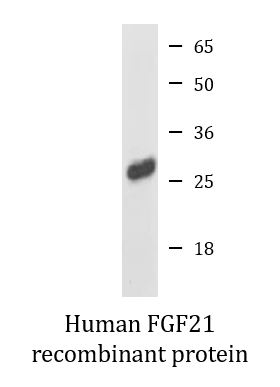
ARG70127 Human FGF21 recombinant protein (Active) (His-tagged, C-ter) SDS-PAGE image
SDS-PAGE analysis of ARG70127 Human FGF21 recombinant protein (Active) (His-tagged, C-ter).