Click to copy cat No.
ARG70186
Click to copy product name
Mouse CD137L / TNFSF9 recombinant protein (Active) (His-tagged, C-ter)
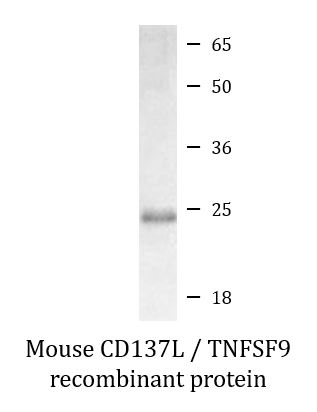
Mouse CD137L / TNFSF9 recombinant protein (Active) (His-tagged, C-ter) for SDS-PAGE
Overview
| Product Description | E. coli expressed, His-tagged (C-ter) Active Mouse CD137L / TNFSF9 recombinant protein |
|---|---|
| Tested Application | SDS-PAGE |
| Target Name | CD137L / TNFSF9 |
| Species | Mouse |
| A.A. Sequence | Arg104 - Glu309 |
| Expression System | E. coli |
| Activity | Active |
| Activity Note | Determined by its ability to induce IL-2 secretion in mouse T cells in the presence of the anti-CD3 antibody. The ED50 for this effect is < 0.05 μg/mL. |
| Alternate Names | 4-1BBL; 4-1BB ligand; Tumor necrosis factor ligand superfamily member 9; 4-1BB-L; CD137L |
Properties
| Form | Powder |
|---|---|
| Purification Note | Endotoxin level is less than 0.1 EU/µg of the protein, as determined by the LAL test. |
| Purity | > 95% (by SDS-PAGE) |
| Buffer | PBS (pH 7.4) |
| Reconstitution | It is recommended to reconstitute the lyophilized protein in sterile water to a concentration not less than 200 μg/mL and incubate the stock solution for at least 20 min at room temperature to make sure the protein is dissolved completely. |
| Storage Instruction | For long term, lyophilized protein should be stored at -20°C or -80°C. After reconstitution, aliquot and store at -20°C or -80°C for up to one month. Storage in frost free freezers is not recommended. Avoid repeated freeze/thaw cycles. Suggest spin the vial prior to opening. |
| Note | For laboratory research only, not for drug, diagnostic or other use. |
Bioinformation
| Gene Symbol | TNFSF9 |
|---|---|
| Gene Full Name | tumor necrosis factor (ligand) superfamily, member 9 |
| Background | The protein encoded by this gene is a cytokine that belongs to the tumor necrosis factor (TNF) ligand family. This transmembrane cytokine is a bidirectional signal transducer that acts as a ligand for TNFRSF9/4-1BB, which is a costimulatory receptor molecule in T lymphocytes. This cytokine and its receptor are involved in the antigen presentation process and in the generation of cytotoxic T cells. The receptor TNFRSF9/4-1BB is absent from resting T lymphocytes but rapidly expressed upon antigenic stimulation. The ligand encoded by this gene, TNFSF9/4-1BBL, has been shown to reactivate anergic T lymphocytes in addition to promoting T lymphocyte proliferation. This cytokine has also been shown to be required for the optimal CD8 responses in CD8 T cells. This cytokine is expressed in carcinoma cell lines, and is thought to be involved in T cell-tumor cell interaction.[provided by RefSeq, Oct 2008] |
| Function | Cytokine that binds to TNFRSF9. Induces the proliferation of activated peripheral blood T-cells. May have a role in activation-induced cell death (AICD). May play a role in cognate interactions between T-cells and B-cells/macrophages. [UniProt] |
| Cellular Localization | Membrane; Single-pass type II membrane protein. [UniProt] |
Images (1) Click the Picture to Zoom In
-
ARG70186 Mouse CD137L / TNFSF9 recombinant protein (Active) (His-tagged, C-ter) SDS-PAGE image
SDS-PAGE analysis of ARG70186 Mouse CD137L / TNFSF9 recombinant protein (Active) (His-tagged, C-ter).