ARG59278
anti-ABLIM3 antibody
anti-ABLIM3 antibody for Western blot and Human
Overview
| Product Description | Rabbit Polyclonal antibody recognizes ABLIM3 |
|---|---|
| Tested Reactivity | Hu |
| Tested Application | WB |
| Host | Rabbit |
| Clonality | Polyclonal |
| Isotype | IgG |
| Target Name | ABLIM3 |
| Antigen Species | Human |
| Immunogen | Synthetic peptide around the middle region of Human ABLIM3. (within the following region: PTYSRQGMSPTFSRSPHHYYRSGPESGRSSPYHSQLDVRSSTPTSYQAPK) |
| Conjugation | Un-conjugated |
| Alternate Names | Actin-binding LIM protein 3; Actin-binding LIM protein family member 3; abLIM-3; HMFN1661 |
Application Instructions
| Application Suggestion |
|
||||
|---|---|---|---|---|---|
| Application Note | * The dilutions indicate recommended starting dilutions and the optimal dilutions or concentrations should be determined by the scientist. | ||||
| Observed Size | ~ 80 kDa |
Properties
| Form | Liquid |
|---|---|
| Purification | Affinity purified. |
| Buffer | PBS, 0.09% (w/v) Sodium azide and 2% Sucrose. |
| Preservative | 0.09% (w/v) Sodium azide |
| Stabilizer | 2% Sucrose |
| Concentration | Batch dependent: 0.5 - 1 mg/ml |
| Storage Instruction | For continuous use, store undiluted antibody at 2-8°C for up to a week. For long-term storage, aliquot and store at -20°C or below. Storage in frost free freezers is not recommended. Avoid repeated freeze/thaw cycles. Suggest spin the vial prior to opening. The antibody solution should be gently mixed before use. |
| Note | For laboratory research only, not for drug, diagnostic or other use. |
Bioinformation
| Database Links | |
|---|---|
| Gene Symbol | ABLIM3 |
| Gene Full Name | actin binding LIM protein family, member 3 |
| Background | The LIM domain is a double zinc finger structure that promotes protein-protein interactions. LIM domain proteins, such as ABLIM3, play roles in embryonic development, cell lineage determination, and cancer (Krupp et al., 2006 [PubMed 16328021]).[supplied by OMIM, Mar 2008] |
| Function | May act as scaffold protein. May stimulate ABRA activity and ABRA-dependent SRF transcriptional activity. [UniProt] |
| Cellular Localization | Cytoplasm. [UniProt] |
| Calculated MW | 78 kDa |
Images (1) Click the Picture to Zoom In
-
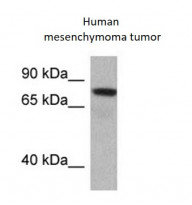
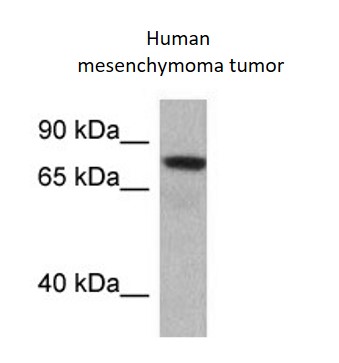
ARG59278 anti-ABLIM3 antibody WB image
Western blot: Human mesenchymoma tumor lysate stained with ARG59278 anti-ABLIM3 antibody at 1 µg/ml dilution.