Click to copy cat No.
ARG43697
Click to copy product name
anti-ADAM15 antibody
anti-ADAM15 antibody for IHC-Formalin-fixed paraffin-embedded sections,Western blot and Human
Overview
| Product Description | Rabbit Polyclonal antibody recognizes ADAM15 |
|---|---|
| Tested Reactivity | Hu |
| Tested Application | IHC-P, WB |
| Host | Rabbit |
| Clonality | Polyclonal |
| Isotype | IgG |
| Target Name | ADAM15 |
| Antigen Species | Human |
| Immunogen | Synthetic peptide corresponding to sequence of Human ADAM15. |
| Conjugation | Un-conjugated |
| Protein Full Name | Disintegrin and metalloproteinase domain-containing protein 15 |
| Alternate Names | ADAM 15; MDC-15; EC 3.4.24.-; Metargidin; Metalloproteinase-like, disintegrin-like, and cysteine-rich protein 15; Metalloprotease RGD disintegrin protein; MDC15; Disintegrin and metalloproteinase domain-containing protein 15 |
Application Instructions
| Application Suggestion |
|
||||||
|---|---|---|---|---|---|---|---|
| Application Note | * The dilutions indicate recommended starting dilutions and the optimal dilutions or concentrations should be determined by the scientist. |
Properties
| Form | Liquid |
|---|---|
| Purification | Affinity purified. |
| Buffer | PBS (pH 7.4), 150 mM NaCl, 0.02% Sodium azide and 50% Glycerol. |
| Preservative | 0.02% Sodium azide |
| Stabilizer | 50% Glycerol |
| Concentration | Batch dependent |
| Storage Instruction | For continuous use, store undiluted antibody at 2-8°C for up to a week. For long-term storage, aliquot and store at -20°C or below. Storage in frost free freezers is not recommended. Avoid repeated freeze/thaw cycles. Suggest spin the vial prior to opening. The antibody solution should be gently mixed before use. |
| Note | For laboratory research only, not for drug, diagnostic or other use. |
Bioinformation
| Database Links |
Swiss-port # Q13444 Human Disintegrin and metalloproteinase domain-containing protein 15 |
|---|---|
| Gene Symbol | ADAM15 |
| Gene Full Name | ADAM metallopeptidase domain 15 |
| Background | The protein encoded by this gene is a member of the ADAM (a disintegrin and metalloproteinase) protein family. ADAM family members are type I transmembrane glycoproteins known to be involved in cell adhesion and proteolytic ectodomain processing of cytokines and adhesion molecules. This protein contains multiple functional domains including a zinc-binding metalloprotease domain, a disintegrin-like domain, as well as a EGF-like domain. Through its disintegrin-like domain, this protein specifically interacts with the integrin beta chain, beta 3. It also interacts with Src family protein-tyrosine kinases in a phosphorylation-dependent manner, suggesting that this protein may function in cell-cell adhesion as well as in cellular signaling. Multiple alternatively spliced transcript variants encoding distinct isoforms have been observed. [provided by RefSeq, Jul 2008] |
| Function | Active metalloproteinase with gelatinolytic and collagenolytic activity. Plays a role in the wound healing process. Mediates both heterotypic intraepithelial cell/T-cell interactions and homotypic T-cell aggregation. Inhibits beta-1 integrin-mediated cell adhesion and migration of airway smooth muscle cells. Suppresses cell motility on or towards fibronectin possibly by driving alpha-v/beta-1 integrin (ITAGV-ITGB1) cell surface expression via ERK1/2 inactivation. Cleaves E-cadherin in response to growth factor deprivation. Plays a role in glomerular cell migration. Plays a role in pathological neovascularization. May play a role in cartilage remodeling. May be proteolytically processed, during sperm epididymal maturation and the acrosome reaction. May play a role in sperm-egg binding through its disintegrin domain. [UniProt] |
| Cellular Localization | Cell junction; Cell projection; Cilium; Cytoplasmic vesicle; Flagellum; Membrane |
| Calculated MW | ~ 110 kDa (reducing conditions) |
| PTM | The precursor is cleaved by a furin endopeptidase. Phosphorylation increases association with PTKs. [UniProt] |
Images (1) Click the Picture to Zoom In
-
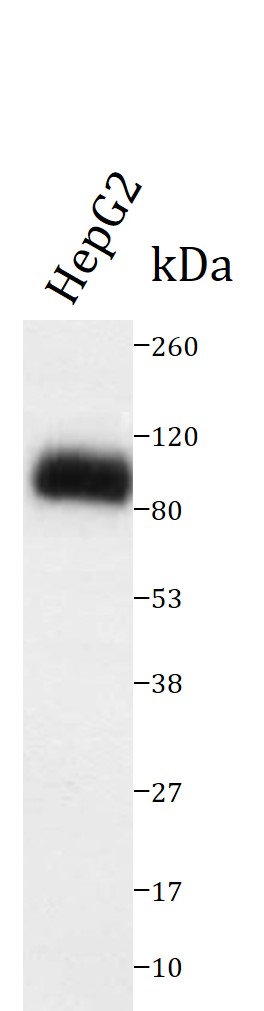
ARG43697 anti-ADAM15 antibody WB image