ARG41301
anti-ASIP antibody
anti-ASIP antibody for Western blot and Human
Overview
| Product Description | Rabbit Polyclonal antibody recognizes ASIP |
|---|---|
| Tested Reactivity | Hu |
| Tested Application | WB |
| Host | Rabbit |
| Clonality | Polyclonal |
| Isotype | IgG |
| Target Name | ASIP |
| Antigen Species | Human |
| Immunogen | Synthetic peptide around the middle region of Human ASIP. (within the following region: CFFTANSHLPPEEKLRDDRSLRSNSSVNLLDVPSVSIVALNKKSKQIGRK) |
| Conjugation | Un-conjugated |
| Alternate Names | Agouti-signaling protein; AGTI; AGTIL; AGSW; ASP; Agouti switch protein; SHEP9 |
Application Instructions
| Application Suggestion |
|
||||
|---|---|---|---|---|---|
| Application Note | * The dilutions indicate recommended starting dilutions and the optimal dilutions or concentrations should be determined by the scientist. | ||||
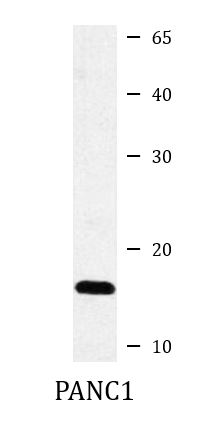
| Positive Control | PANC1 | ||||
| Observed Size | 16 kDa |
Properties
| Form | Liquid |
|---|---|
| Purification | Affinity purified. |
| Buffer | PBS, 0.09% (w/v) Sodium azide and 2% Sucrose. |
| Preservative | 0.09% (w/v) Sodium azide |
| Stabilizer | 2% Sucrose |
| Concentration | Batch dependent: 0.5 - 1 mg/ml |
| Storage Instruction | For continuous use, store undiluted antibody at 2-8°C for up to a week. For long-term storage, aliquot and store at -20°C or below. Storage in frost free freezers is not recommended. Avoid repeated freeze/thaw cycles. Suggest spin the vial prior to opening. The antibody solution should be gently mixed before use. |
| Note | For laboratory research only, not for drug, diagnostic or other use. |
Bioinformation
| Database Links | |
|---|---|
| Gene Symbol | ASIP |
| Gene Full Name | agouti signaling protein |
| Background | In mice, the agouti gene encodes a paracrine signaling molecule that causes hair follicle melanocytes to synthesize pheomelanin, a yellow pigment, instead of the black or brown pigment, eumelanin. Pleiotropic effects of constitutive expression of the mouse gene include adult-onset obesity, increased tumor susceptibility, and premature infertility. This gene is highly similar to the mouse gene and encodes a secreted protein that may (1) affect the quality of hair pigmentation, (2) act as a pharmacological antagonist of alpha-melanocyte-stimulating hormone, (3) play a role in neuroendocrine aspects of melanocortin action, and (4) have a functional role in regulating lipid metabolism in adipocytes. [provided by RefSeq, Jul 2008] |
| Function | Involved in the regulation of melanogenesis. The binding of ASP to MC1R precludes alpha-MSH initiated signaling and thus blocks production of cAMP, leading to a down-regulation of eumelanogenesis (brown/black pigment) and thus increasing synthesis of pheomelanin (yellow/red pigment). In higher primates, agouti may affect the quality of hair pigmentation rather than its pattern of deposition. Could well play a role in neuroendocrine aspects of melanocortin action. May have some functional role in regulating the lipid metabolism with adipocytes. [UniProt] |
| Cellular Localization | Secreted. [UniProt] |
| Calculated MW | 15 kDa |
Images (1) Click the Picture to Zoom In
-
ARG41301 anti-ASIP antibody WB image
Western blot: PANC1 whole cell lysate stained with ARG41301 anti-ASIP antibody at 1 µg/ml dilution.