Click to copy cat No.
ARG10540
Click to copy product name
anti-Annexin A1 antibody [ANEX 5E4/1]
anti-Annexin A1 antibody [ANEX 5E4/1] for ELISA,ICC/IF,IHC-Formalin-fixed paraffin-embedded sections,Immunoprecipitation,Western blot and Human
Signaling Transduction antibody

1
Overview
| Product Description | Mouse Monoclonal antibody [5E4/1] recognizes Annexin A1 |
|---|---|
| Tested Reactivity | Hu |
| Tested Application | ELISA, ICC/IF, IHC-P, IP, WB |
| Host | Mouse |
| Clonality | Monoclonal |
| Clone | ANEX 5E4/1 |
| Isotype | IgG1 |
| Target Name | Annexin A1 |
| Antigen Species | Human |
| Immunogen | Mixture of native membrane proteins from human bone tissues which includes native whole annexin proteins. |
| Conjugation | Un-conjugated |
| Alternate Names | ANX1; LPC1; Annexin I; Annexin-1; Calpactin II; Calpactin-2; Chromobindin-9; Lipocortin I; Phospholipase A2 inhibitory protein; p35 |
Application Instructions
| Application Suggestion |
|
||||||||||||
|---|---|---|---|---|---|---|---|---|---|---|---|---|---|
| Application Note | * The dilutions indicate recommended starting dilutions and the optimal dilutions or concentrations should be determined by the scientist. | ||||||||||||
| Positive Control | Endothelial cells |
Properties
| Form | Liquid |
|---|---|
| Purification | Affinity purified |
| Buffer | PBS and 0.02% Sodium azide |
| Preservative | 0.02% Sodium azide |
| Concentration | 0.9 mg/ml |
| Storage Instruction | For continuous use, store undiluted antibody at 2-8°C for up to a week. For long-term storage, aliquot and store at -20°C or below. Storage in frost free freezers is not recommended. Avoid repeated freeze/thaw cycles. Suggest spin the vial prior to opening. The antibody solution should be gently mixed before use. |
| Note | For laboratory research only, not for drug, diagnostic or other use. |
Bioinformation
| Database Links | |
|---|---|
| Gene Symbol | ANXA1 |
| Gene Full Name | annexin A1 |
| Background | This gene encodes a membrane-localized protein that binds phospholipids. This protein inhibits phospholipase A2 and has anti-inflammatory activity. Loss of function or expression of this gene has been detected in multiple tumors. [provided by RefSeq, Dec 2014] |
| Function | Annexin A1 Plays important roles in the innate immune response as effector of glucocorticoid-mediated responses and regulator of the inflammatory process. Has anti-inflammatory activity (PubMed:8425544). Promotes resolution of inflammation and wound healing (PubMed:25664854). Functions at least in part by activating the formyl peptide receptors and downstream signaling cascades (PubMed:15187149, PubMed:25664854). Promotes chemotaxis of granulocytes and monocytes via activation of the formyl peptide receptors (PubMed:15187149). Contributes to the adaptive immune response by enhancing signaling cascades that are triggered by T-cell activation, regulates differentiation and proliferation of activated T-cells (PubMed:17008549). Promotes the differentiation of T-cells into Th1 cells and negatively regulates differentiation into Th2 cells (PubMed:17008549). . Promotes rearrangement of the actin cytoskeleton, cell polarization and cell migration (PubMed:15187149). Negatively regulates hormone exocytosis via activation of the formyl peptide receptors and reorganization of the actin cytoskeleton (PubMed:19625660). Has high affinity for Ca2+ and can bind up to eight Ca2+ ions (By similarity). Displays Ca2+-dependent binding to phospholipid membranes (PubMed:2532504, PubMed:8557678). [provide by Uniprot] |
| Research Area | Signaling Transduction antibody |
| Calculated MW | 39 kDa |
| PTM | Phosphorylated by protein kinase C, EGFR and TRPM7 (PubMed:2457390, PubMed:15485879). Phosphorylated in response to EGF treatment (PubMed:2532504). Sumoylated. |
Images (1) Click the Picture to Zoom In
-
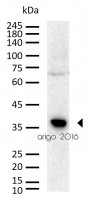
ARG10540 anti-Annexin A1 antibody [ANEX 5E4/1] WB image
Western blot: 30 µg of HeLa cell lysate stained with ARG10540 anti-Annexin A1 antibody [ANEX 5E4/1] at 1:500 dilution.
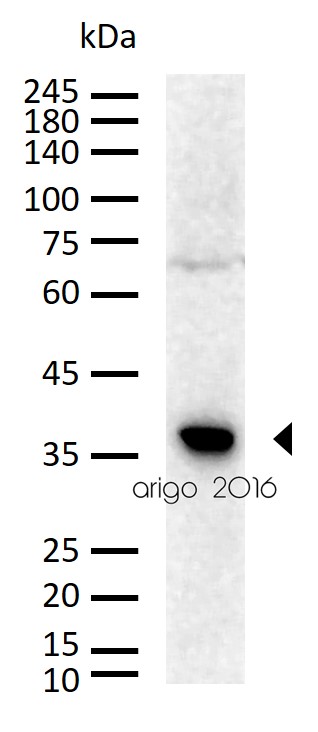
Customer's Feedback
Excellent

Review for anti-Annexin A1 antibody [ANEX 5E4/1]
Application:WB
Sample:HeLa
Sample Loading Amount:30 µg
Primary Antibody Dilution Factor:1:500
Primary Antibody Incubation Time:overnight
Primary Antibody Incubation Temperature:4 ºC




