ARG44630
anti-BRAP antibody
anti-BRAP antibody for Immunoprecipitation and Human
Gene Regulation antibody; Signaling Transduction antibody
Overview
| Product Description | Mouse Monoclonal antibody recognizes BRAP |
|---|---|
| Tested Reactivity | Hu |
| Tested Application | IP |
| Host | Mouse |
| Clonality | Monoclonal |
| Isotype | IgG2b |
| Target Name | BRAP |
| Antigen Species | Human |
| Conjugation | Un-conjugated |
| Alternate Names | BRAP; BRCA1 Associated Protein; BRAP2; RNF52; IMP; Impedes Mitogenic Signal Propagation; RING-Type E3 Ubiquitin Transferase BRAP2; Renal Carcinoma Antigen NY-REN-63; Galectin-2-Binding Protein; BRCA1-Associated Protein; RING Finger Protein 52; EC 2.3.2.27 |
Application Instructions
| Application Suggestion |
|
||||
|---|---|---|---|---|---|
| Application Note | * The dilutions indicate recommended starting dilutions and the optimal dilutions or concentrations should be determined by the scientist. |
Properties
| Form | Liquid |
|---|---|
| Purification | Protein A purification |
| Buffer | PBS with 0.09% sodium azide |
| Preservative | 0.09% sodium azide |
| Storage Instruction | For continuous use, store undiluted antibody at 2-8°C for up to a week. For long-term storage, aliquot and store at -20°C or below. Storage in frost free freezers is not recommended. Avoid repeated freeze/thaw cycles. Suggest spin the vial prior to opening. The antibody solution should be gently mixed before use. |
| Note | For laboratory research only, not for drug, diagnostic or other use. |
Bioinformation
| Database Links | |
|---|---|
| Gene Symbol | BRAP |
| Gene Full Name | BRCA1 Associated Protein |
| Background | The protein encoded by this gene was identified by its ability to bind to the nuclear localization signal of BRCA1 and other proteins. It is a cytoplasmic protein which may regulate nuclear targeting by retaining proteins with a nuclear localization signal in the cytoplasm. [provided by RefSeq, Jul 2008] |
| Function | Negatively regulates MAP kinase activation by limiting the formation of Raf/MEK complexes probably by inactivation of the KSR1 scaffold protein. Also acts as a Ras responsive E3 ubiquitin ligase that, on activation of Ras, is modified by auto-polyubiquitination resulting in the release of inhibition of Raf/MEK complex formation. May also act as a cytoplasmic retention protein with a role in regulating nuclear transport. [UniProt] |
| Cellular Localization | Cytoplasm. [UniProt] |
| Research Area | Gene Regulation antibody; Signaling Transduction antibody |
| PTM | Phosphoprotein. [UniProt] |
Images (1) Click the Picture to Zoom In
-
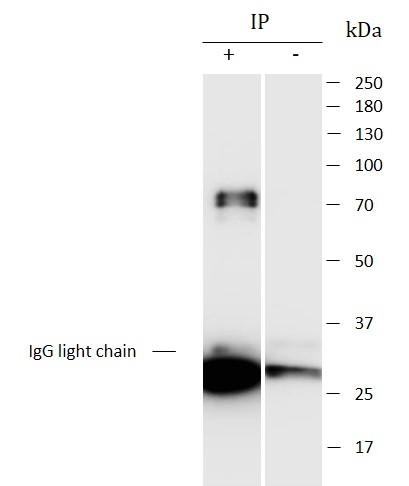
ARG44630 anti-BRAP antibody IP image
Immunoprecipitation: A549 lysate immunoprecipitated with 2.5 µg of ARG44630 anti-BRAP antibody.