Click to copy cat No.
ARG57312
Click to copy product name
anti-CBLB antibody
anti-CBLB antibody for Western blot and Human,Mouse,Rat
Overview
| Product Description | Rabbit Polyclonal antibody recognizes CBLB |
|---|---|
| Tested Reactivity | Hu, Ms, Rat |
| Tested Application | WB |
| Host | Rabbit |
| Clonality | Polyclonal |
| Isotype | IgG |
| Target Name | CBLB |
| Antigen Species | Human |
| Immunogen | Recombinant Protein of Human CBLB. |
| Conjugation | Un-conjugated |
| Alternate Names | Nbla00127; EC 6.3.2.-; RNF56; Signal transduction protein CBL-B; Casitas B-lineage lymphoma proto-oncogene b; SH3-binding protein CBL-B; Cbl-b; E3 ubiquitin-protein ligase CBL-B; RING finger protein 56 |
Application Instructions
| Application Suggestion |
|
||||
|---|---|---|---|---|---|
| Application Note | * The dilutions indicate recommended starting dilutions and the optimal dilutions or concentrations should be determined by the scientist. | ||||
| Positive Control | Jurkat |
Properties
| Form | Liquid |
|---|---|
| Purification | Affinity purification with immunogen. |
| Buffer | PBS (pH 7.3), 0.02% Sodium azide and 50% Glycerol. |
| Preservative | 0.02% Sodium azide |
| Stabilizer | 50% Glycerol |
| Storage Instruction | For continuous use, store undiluted antibody at 2-8°C for up to a week. For long-term storage, aliquot and store at -20°C. Storage in frost free freezers is not recommended. Avoid repeated freeze/thaw cycles. Suggest spin the vial prior to opening. The antibody solution should be gently mixed before use. |
| Note | For laboratory research only, not for drug, diagnostic or other use. |
Bioinformation
| Database Links | |
|---|---|
| Gene Symbol | CBLB |
| Gene Full Name | Cbl proto-oncogene B, E3 ubiquitin protein ligase |
| Function | E3 ubiquitin-protein ligase which accepts ubiquitin from specific E2 ubiquitin-conjugating enzymes, and transfers it to substrates, generally promoting their degradation by the proteasome. Negatively regulates TCR (T-cell receptor), BCR (B-cell receptor) and FCER1 (high affinity immunoglobulin epsilon receptor) signal transduction pathways. In naive T-cells, inhibits VAV1 activation upon TCR engagement and imposes a requirement for CD28 costimulation for proliferation and IL-2 production. Also acts by promoting PIK3R1/p85 ubiquitination, which impairs its recruitment to the TCR and subsequent activation. In activated T-cells, inhibits PLCG1 activation and calcium mobilization upon restimulation and promotes anergy. In B-cells, acts by ubiquitinating SYK and promoting its proteasomal degradation. Slightly promotes SRC ubiquitination. May be involved in EGFR ubiquitination and internalization. May be functionally coupled with the E2 ubiquitin-protein ligase UB2D3. [UniProt] |
| Calculated MW | 109 kDa |
| PTM | Phosphorylated on tyrosine and serine residues upon TCR or BCR activation, and upon various types of cell stimulation. Auto-ubiquitinated upon EGF-mediated cell activation or upon T-cell costimulation by CD28; which promotes proteasomal degradation. |
Images (1) Click the Picture to Zoom In
-
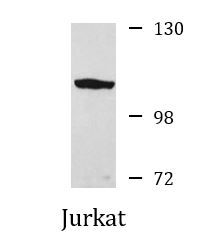
ARG57312 anti-CBLB antibody WB image
Western blot: Jurkat cell lysate stained with ARG57312 anti-CBLB antibody.