ARG54221
anti-CD101 antibody [BB27] (PE)
anti-CD101 antibody [BB27] (PE) for Flow cytometry and Human
Immune System antibody
Overview
| Product Description | PE-conjugated Mouse Monoclonal antibody [BB27] recognizes CD101 |
|---|---|
| Tested Reactivity | Hu |
| Tested Application | FACS |
| Specificity | The clone BB27 recognizes CD101, a 140 kDa disulfide-bonded homodimeric protein expressed on activated T cells, and some ther cell types, such as granulocytes and cells of the monocyte/macropgage lineage. HLDA V; WS Code T040 |
| Host | Mouse |
| Clonality | Monoclonal |
| Clone | BB27 |
| Isotype | IgG1 |
| Target Name | CD101 |
| Antigen Species | Human |
| Immunogen | Human thymic clone B12 |
| Conjugation | PE |
| Alternate Names | Immunoglobulin superfamily member 2; IgSF2; CD antigen CD101; Cell surface glycoprotein V7; EWI-101; IGSF2; V7; Glu-Trp-Ile EWI motif-containing protein 101 |
Application Instructions
| Application Suggestion |
|
||||
|---|---|---|---|---|---|
| Application Note | * The dilutions indicate recommended starting dilutions and the optimal dilutions or concentrations should be determined by the scientist. |
Properties
| Form | Liquid |
|---|---|
| Purification Note | The purified antibody is conjugated with R-Phycoerythrin (PE) under optimum conditions. The conjugate is purified by size-exclusion chromatography and adjusted for direct use. No reconstitution is necessary. |
| Buffer | PBS, 15 mM Sodium azide and 0.2% (w/v) high-grade protease free BSA |
| Preservative | 15 mM Sodium azide |
| Stabilizer | 0.2% (w/v) high-grade protease free BSA |
| Storage Instruction | Aliquot and store in the dark at 2-8°C. Keep protected from prolonged exposure to light. Avoid repeated freeze/thaw cycles. Suggest spin the vial prior to opening. The antibody solution should be gently mixed before use. |
| Note | For laboratory research only, not for drug, diagnostic or other use. |
Bioinformation
| Database Links |
Swiss-port # Q93033 Human Immunoglobulin superfamily member 2 |
|---|---|
| Gene Symbol | CD101 |
| Gene Full Name | CD101 molecule |
| Background | CD101 is a type I transmembrane glycoprotein, which forms disulfide-linked homodimers. It is expressed on activated T cells, as well as on granulocytes, monocytes, dendritic cells or mucosal T cells. It plays a major role in the activation of T cells by skin dendritic cells. Function of CD101 has not been fully elucidated, but in mice its knock-out results in liver autoimmune disease induced by Novosphingobium aromaticivorans. |
| Function | Plays a role as inhibitor of T-cells proliferation induced by CD3. Inhibits expression of IL2RA on activated T-cells and secretion of IL2. Inhibits tyrosine kinases that are required for IL2 production and cellular proliferation. Inhibits phospholipase C-gamma-1/PLCG1 phosphorylation and subsequent CD3-induced changes in intracellular free calcium. Prevents nuclear translocation of nuclear factor of activated T-cell to the nucleus. Plays a role in the inhibition of T-cell proliferation via IL10 secretion by cutaneous dendritic cells. May be a marker of CD4(+) CD56(+) leukemic tumor cells. [UniProt] |
| Research Area | Immune System antibody |
| Calculated MW | 115 kDa |
| PTM | N-glycosylated. |
Images (1) Click the Picture to Zoom In
-
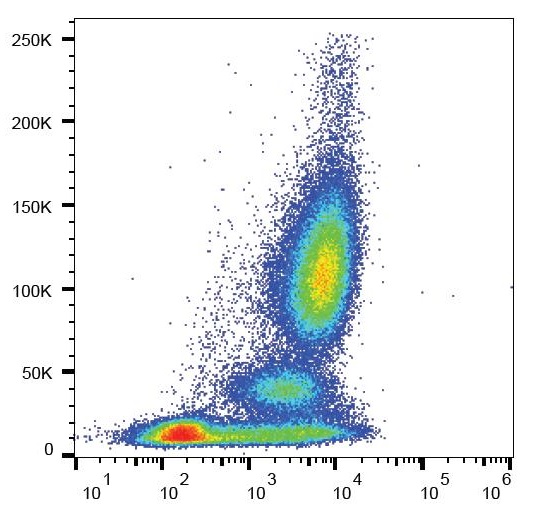
ARG54221 anti-CD101 antibody [BB27] (PE) FACS image
Flow Cytometry: Human peripheral blood stained with ARG54221 anti-CD101 antibody [BB27] (PE).