ARG62703
anti-CD106 / VCAM1 antibody [STA] (Biotin)
anti-CD106 / VCAM1 antibody [STA] (Biotin) for Flow cytometry and Human
Cancer antibody; Cell Biology and Cellular Response antibody; Developmental Biology antibody; Neuroscience antibody; Signaling Transduction antibody
Overview
| Product Description | Biotin-conjugated Mouse Monoclonal antibody [STA] recognizes CD106 / VCAM1 |
|---|---|
| Tested Reactivity | Hu |
| Tested Application | FACS |
| Specificity | The clone STA recognizes CD106 antigen (VCAM-1), a 100-110 kDa type I membrane protein of the immunoglobulin superfamily, a crucial mediator of leukocyte adhesion, and a costimulation molecule. HLDA V; WS Code A013 |
| Host | Mouse |
| Clonality | Monoclonal |
| Clone | STA |
| Isotype | IgG1 |
| Target Name | CD106 / VCAM1 |
| Antigen Species | Human |
| Immunogen | Human DS6 T cell line |
| Conjugation | Biotin |
| Alternate Names | CD106; INCAM-100; Vascular cell adhesion protein 1; VCAM-1; CD antigen CD106; V-CAM 1 |
Application Instructions
| Application Suggestion |
|
||||
|---|---|---|---|---|---|
| Application Note | * The dilutions indicate recommended starting dilutions and the optimal dilutions or concentrations should be determined by the scientist. |
Properties
| Form | Liquid |
|---|---|
| Purification Note | The purified antibody is conjugated with Biotin-LC-NHS under optimum conditions. The reagent is free of unconjugated biotin. |
| Buffer | PBS (pH 7.4) and 15 mM Sodium azide |
| Preservative | 15 mM Sodium azide |
| Concentration | 1 mg/ml |
| Storage Instruction | Aliquot and store in the dark at 2-8°C. Keep protected from prolonged exposure to light. Avoid repeated freeze/thaw cycles. Suggest spin the vial prior to opening. The antibody solution should be gently mixed before use. |
| Note | For laboratory research only, not for drug, diagnostic or other use. |
Bioinformation
| Database Links | |
|---|---|
| Gene Symbol | VCAM1 |
| Gene Full Name | vascular cell adhesion molecule 1 |
| Background | CD106 / VCAM-1 (vascular cell adhesion molecule-1) is an Ig-like cell surface adhesion molecule binding VLA-4 integrin. VCAM-1 is a potent T cell costimulatory molecule taking part in their positive selection and survival, as well as in adhesion, transendothelial migration and activation of peripheral T cells. VCAM-1 is also involved in endothelial cell-cell contacts. Whereas VCAM-1 normally mediates leukocyte extravasion to sites of tissue inflammation, tumour cells can use overexpressed VCAM-1 to escape T cell immunity. Soluble form of VCAM-1 (sVCAM-1) is an inflammatory marker and can be used also in prognosis of subsequent cariovascular events following acute coronary syndromes. |
| Function | Important in cell-cell recognition. Appears to function in leukocyte-endothelial cell adhesion. Interacts with integrin alpha-4/beta-1 (ITGA4/ITGB1) on leukocytes, and mediates both adhesion and signal transduction. The VCAM1/ITGA4/ITGB1 interaction may play a pathophysiologic role both in immune responses and in leukocyte emigration to sites of inflammation. [UniProt] |
| Research Area | Cancer antibody; Cell Biology and Cellular Response antibody; Developmental Biology antibody; Neuroscience antibody; Signaling Transduction antibody |
| Calculated MW | 81 kDa |
| PTM | Sialoglycoprotein. |
Images (1) Click the Picture to Zoom In
-
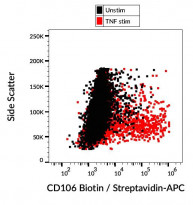
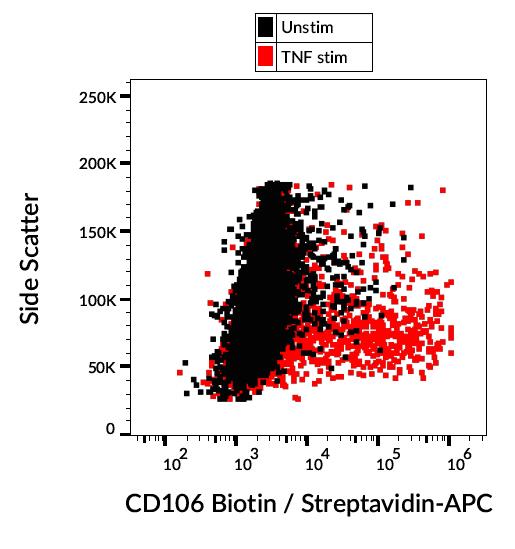
ARG62703 anti-CD106 / VCAM1 antibody [STA] (Biotin) FACS image
Flow Cytometry: TNF alpha-stimulated HUVEC cells (red) and unstimulated HUVEC cells (black) stained with ARG62703 anti-CD106 / VCAM1 antibody [STA] (Biotin), followed by Streptavidin (APC).
Clone References
Modeling the early events of severe acute respiratory syndrome coronavirus infection in vitro.


Expression of VCAM-1 (CD106) by a subset of TCR gamma delta-bearing lymphocyte clones. Involvement of a metalloprotease in the specific hydrolytic release of the soluble isoform.




