Click to copy cat No.
ARG21002
Click to copy product name
anti-CD152 / CTLA4 antibody [1B8] (FITC)
anti-CD152 / CTLA4 antibody [1B8] (FITC) for ELISA,Flow cytometry and Mouse
Overview
| Product Description | FITC-conjugated Hamster Monoclonal antibody [1B8] recognizes CD152 / CTLA4 |
|---|---|
| Tested Reactivity | Ms |
| Tested Application | ELISA, FACS |
| Specificity | Mouse CD152. |
| Host | Hamster |
| Clonality | Monoclonal |
| Clone | 1B8 |
| Isotype | IgG1 |
| Target Name | CD152 / CTLA4 |
| Antigen Species | Mouse |
| Immunogen | Extracellular portion of murine CTLA-4 fused to a murine IgG2a |
| Conjugation | FITC |
| Alternate Names | GRD4; CTLA-4; CELIAC3; CD; Cytotoxic T-lymphocyte-associated antigen 4; CD152; GSE; CD antigen CD152; Cytotoxic T-lymphocyte protein 4; ALPS5; IDDM12 |
Application Instructions
| Application Suggestion |
|
||||||
|---|---|---|---|---|---|---|---|
| Application Note | * The dilutions indicate recommended starting dilutions and the optimal dilutions or concentrations should be determined by the scientist. |
Properties
| Form | Liquid |
|---|---|
| Buffer | PBS and 0.1% Sodium azide. |
| Preservative | 0.1% Sodium azide |
| Concentration | 0.5 mg/ml |
| Storage Instruction | Aliquot and store in the dark at 2-8°C. Keep protected from prolonged exposure to light. Avoid repeated freeze/thaw cycles. Suggest spin the vial prior to opening. The antibody solution should be gently mixed before use. |
| Note | For laboratory research only, not for drug, diagnostic or other use. |
Bioinformation
| Database Links | |
|---|---|
| Gene Symbol | CTLA4 |
| Gene Full Name | cytotoxic T-lymphocyte-associated protein 4 |
| Background | This gene is a member of the immunoglobulin superfamily and encodes a protein which transmits an inhibitory signal to T cells. The protein contains a V domain, a transmembrane domain, and a cytoplasmic tail. Alternate transcriptional splice variants, encoding different isoforms, have been characterized. The membrane-bound isoform functions as a homodimer interconnected by a disulfide bond, while the soluble isoform functions as a monomer. Mutations in this gene have been associated with insulin-dependent diabetes mellitus, Graves disease, Hashimoto thyroiditis, celiac disease, systemic lupus erythematosus, thyroid-associated orbitopathy, and other autoimmune diseases. [provided by RefSeq, Jul 2008] |
| Function | Inhibitory receptor acting as a major negative regulator of T-cell responses. The affinity of CTLA4 for its natural B7 family ligands, CD80 and CD86, is considerably stronger than the affinity of their cognate stimulatory coreceptor CD28. [UniProt] |
| Calculated MW | 25 kDa |
| PTM | N-glycosylation is important for dimerization. Phosphorylation at Tyr-201 prevents binding to the AP-2 adapter complex, blocks endocytosis, and leads to retention of CTLA4 on the cell surface. |
Images (1) Click the Picture to Zoom In
-
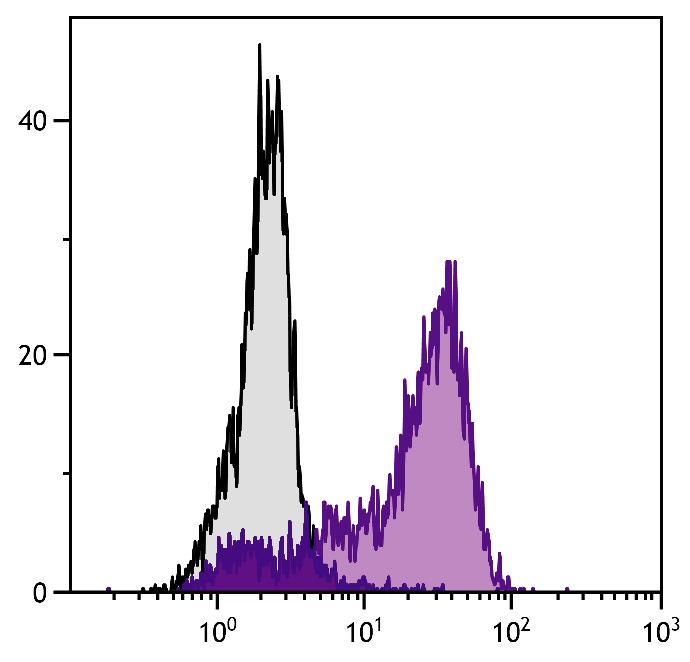
ARG21002 anti-CD152 / CTLA4 antibody [1B8] (FITC) FACS image
Flow Cytometry: Con-A and IL-2-stimulated BALB/c Mouse splenocytes stained with ARG21002 anti-CD152 / CTLA4 antibody [1B8] (FITC).