ARG42264
anti-CD24 antibody [SN3] (APC)
anti-CD24 antibody [SN3] (APC) for Flow cytometry and Human
Overview
| Product Description | APC-conjugated Mouse Monoclonal antibody [SN3] recognizes CD24 |
|---|---|
| Tested Reactivity | Hu |
| Tested Application | FACS |
| Specificity | The antibody SN3 reacts with CD24, a 35-45 kDa heavily glycosylated cell surface antigen. CD24 is expressed by granulocytes, B lymphocytes and by some activated T cells and T cell malignancies. It is not expressed on human thymocytes. |
| Host | Mouse |
| Clonality | Monoclonal |
| Clone | SN3 |
| Isotype | IgG1 |
| Target Name | CD24 |
| Antigen Species | Human |
| Immunogen | Glycoproteins purified from Human NALM-1 cell line. |
| Conjugation | APC |
| Alternate Names | Signal transducer CD24; CD antigen CD24; CD24A; Small cell lung carcinoma cluster 4 antigen |
Application Instructions
| Application Suggestion |
|
||||
|---|---|---|---|---|---|
| Application Note | * The dilutions indicate recommended starting dilutions and the optimal dilutions or concentrations should be determined by the scientist. |
Properties
| Form | Liquid |
|---|---|
| Purification | Purified |
| Buffer | PBS and 15 mM Sodium azide. |
| Preservative | 15 mM Sodium azide |
| Storage Instruction | Aliquot and store in the dark at 2-8°C. Keep protected from prolonged exposure to light. Avoid repeated freeze/thaw cycles. Suggest spin the vial prior to opening. The antibody solution should be gently mixed before use. |
| Note | For laboratory research only, not for drug, diagnostic or other use. |
Bioinformation
| Database Links | |
|---|---|
| Gene Symbol | CD24 |
| Gene Full Name | CD24 molecule |
| Background | This gene encodes a sialoglycoprotein that is expressed on mature granulocytes and B cells and modulates growth and differentiation signals to these cells. The precursor protein is cleaved to a short 32 amino acid mature peptide which is anchored via a glycosyl phosphatidylinositol (GPI) link to the cell surface. This gene was missing from previous genome assemblies, but is properly located on chromosome 6. Non-transcribed pseudogenes have been designated on chromosomes 1, 15, 20, and Y. Alternative splicing results in multiple transcript variants. [provided by RefSeq, Apr 2014] |
| Function | May have a pivotal role in cell differentiation of different cell types. Signaling could be triggered by the binding of a lectin-like ligand to the CD24 carbohydrates, and transduced by the release of second messengers derived from the GPI-anchor. Modulates B-cell activation responses. Promotes AG-dependent proliferation of B-cells, and prevents their terminal differentiation into antibody-forming cells (PubMed:11313396). In association with SIGLEC10 may be involved in the selective suppression of the immune response to danger-associated molecular patterns (DAMPs) such as HMGB1, HSP70 and HSP90. Plays a role in the control of autoimmunity (By similarity). [UniProt] |
| Cellular Localization | Cell membrane; Lipid-anchor, GPI-anchor. [UniProt] |
| Calculated MW | 8 kDa |
| PTM | Extensively O-glycosylated. [UniProt] |
Images (1) Click the Picture to Zoom In
-
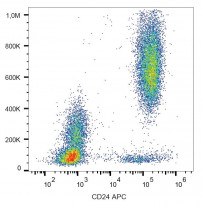
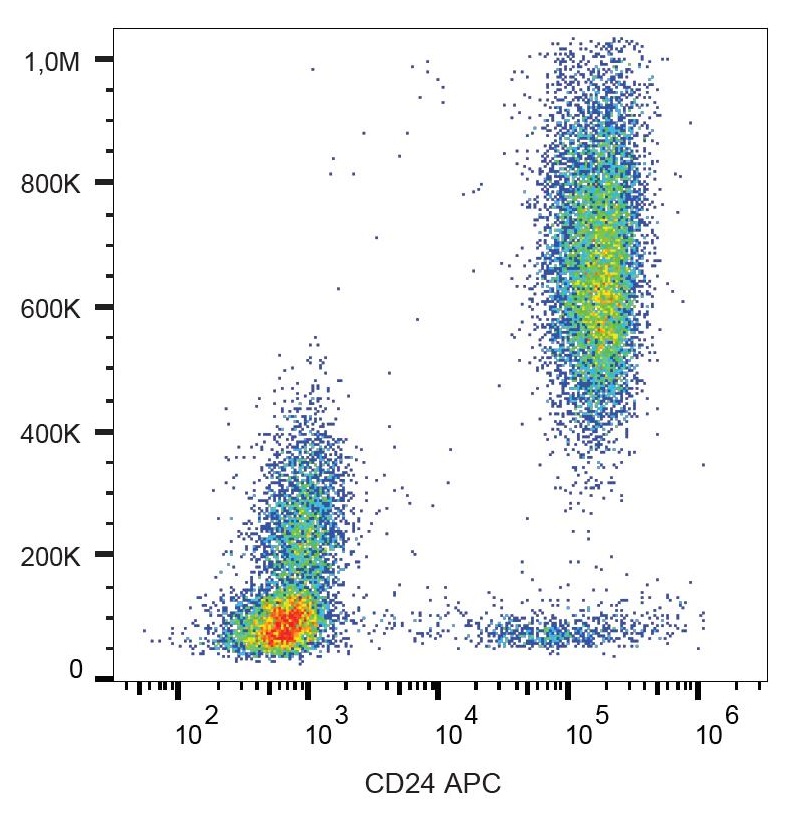
ARG42264 anti-CD24 antibody [SN3] (APC) FACS image
Flow Cytometry: Human peripheral blood cells stained with ARG42264 anti-CD24 antibody [SN3] (APC).