ARG53868
anti-CD5 antibody [CRIS1] (PE)
anti-CD5 antibody [CRIS1] (PE) for Flow cytometry and Human
Developmental Biology antibody; Immune System antibody
Overview
| Product Description | PE-conjugated Mouse Monoclonal antibody [CRIS1] recognizes CD5 |
|---|---|
| Tested Reactivity | Hu |
| Tested Application | FACS |
| Specificity | The clone CRIS1 reacts with the cell surface glycoprotein CD5, a 67kDa single-chain transmembrane glycoprotein expressed on mature T lymphocytes, most of thymocytes and B lymphocytes subset (B-1a lymphocytes). HLDA I; WS Code T 29 HLDA III; WS Code T 530 |
| Host | Mouse |
| Clonality | Monoclonal |
| Clone | CRIS1 |
| Isotype | IgG2a |
| Target Name | CD5 |
| Antigen Species | Human |
| Immunogen | stimulated human leukocytes |
| Conjugation | PE |
| Alternate Names | CD antigen CD5; Lymphocyte antigen T1/Leu-1; LEU1; T-cell surface glycoprotein CD5; T1 |
Application Instructions
| Application Suggestion |
|
||||
|---|---|---|---|---|---|
| Application Note | * The dilutions indicate recommended starting dilutions and the optimal dilutions or concentrations should be determined by the scientist. |
Properties
| Form | Liquid |
|---|---|
| Purification Note | The purified antibody is conjugated with R-Phycoerythrin (PE) under optimum conditions. The conjugate is purified by size-exclusion chromatography and adjusted for direct use. No reconstitution is necessary. |
| Buffer | PBS, 15 mM Sodium azide and 0.2% (w/v) high-grade protease free BSA |
| Preservative | 15 mM Sodium azide |
| Stabilizer | 0.2% (w/v) high-grade protease free BSA |
| Storage Instruction | Aliquot and store in the dark at 2-8°C. Keep protected from prolonged exposure to light. Avoid repeated freeze/thaw cycles. Suggest spin the vial prior to opening. The antibody solution should be gently mixed before use. |
| Note | For laboratory research only, not for drug, diagnostic or other use. |
Bioinformation
| Database Links | |
|---|---|
| Gene Symbol | CD5 |
| Gene Full Name | CD5 molecule |
| Background | CD5 antigen (T1; 67 kDa) is a human cell surface T-lymphocyte single-chain transmembrane glycoprotein. CD5 is expressed on all mature T-lymphocytes, most of thymocytes, subset of B-lymphocytes and on many T-cell leukemias and lymphomas. It is a type I membrane glycoprotein whose extracellular region contains three scavenger receptor cysteine-rich (SRCR) domains. The CD5 is a signal transducing molecule whose cytoplasmic tail is devoid of any intrinsic catalytic activity. CD5 modulates signaling through the antigen-specific receptor complex (TCR and BCR). CD5 crosslinking induces extracellular Ca++ mobilization, tyrosine phosphorylation of intracellular proteins and DAG production. Preliminary evidence shows protein associations with ZAP-70, p56lck, p59fyn, PC-PLC, etc. CD5 may serve as a dual receptor, giving either stimulatory or inhibitory signals depending both on the cell type and development stage. In thymocytes and B1a cells seems to provide inhibitory signals, in peripheral mature T lymhocytes it acts as a costimulatory signal receptor. CD5 is the phenotypic marker of a B cell subpopulation involved in the production of autoreactive antibodies. Disease relevance: CD5 is a phenotypic marker for some B cell lymphoproliferative disorders (B-CLL, Hairy cell leukemia, etc.). The CD5+ popuation is expanded in some autoimmune disorders (Rheumatoid Arthritis, etc.). Herpes virus infections induce loss of CD5 expression in the expanded CD8+ human T cells. |
| Function | May act as a receptor in regulating T-cell proliferation. [UniProt] |
| Research Area | Developmental Biology antibody; Immune System antibody |
| Calculated MW | 55 kDa |
| PTM | Phosphorylated on tyrosine residues by LYN; this creates binding sites for PTPN6/SHP-1. |
Images (1) Click the Picture to Zoom In
-
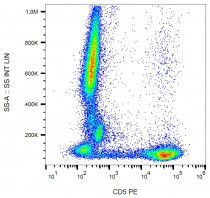
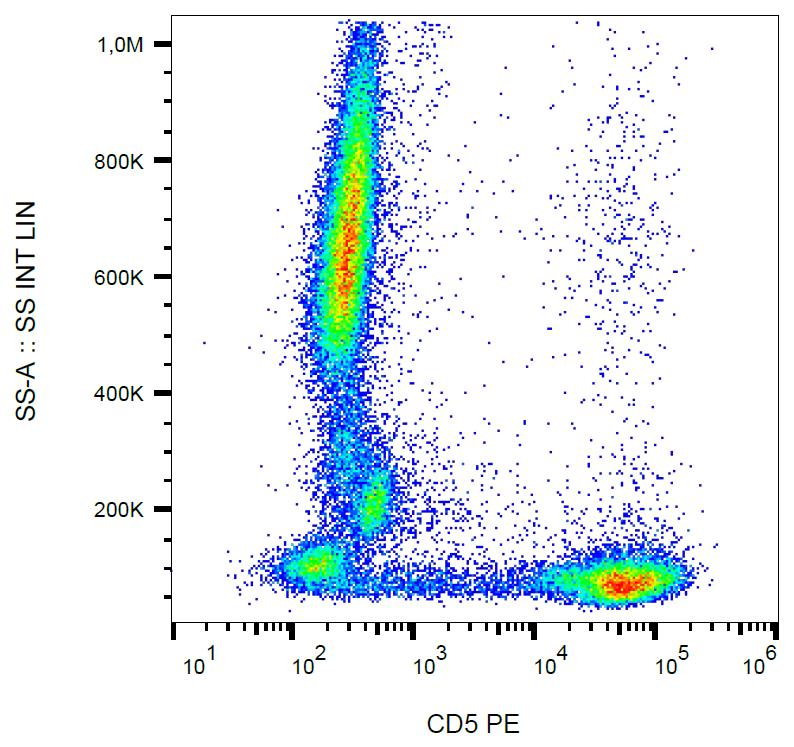
ARG53868 anti-CD5 antibody [CRIS1] (PE) FACS image
Flow Cytometry: Human peripheral blood stained with ARG53868 anti-CD5 antibody [CRIS1] (PE).
Clone References
Conformation of the hypervariable region L3 without the key proline residue.


The clusters of differentiation (CD) defined by the First International Workshop on Human Leucocyte Differentiation Antigens.
Cellular immunity analysis using monoclonal antibodies in human glomerulonephritis.
Intracellular events involved in CD5-induced human T cell activation and proliferation.




