ARG53872
anti-CD53 antibody [MEM-53] (PE)
anti-CD53 antibody [MEM-53] (PE) for Flow cytometry and Human
Immune System antibody; Signaling Transduction antibody
Overview
| Product Description | PE-conjugated Mouse Monoclonal antibody [MEM-53] recognizes CD53 |
|---|---|
| Tested Reactivity | Hu |
| Tested Application | FACS |
| Specificity | The clone MEM-53 reacts with CD53, a 32-40 kDa tetraspanin family glycoprotein exclusivelly expressed on leukocytes; it is not present on platelets, red blood cells and non-hematopoietic cells. MEM-53 reacts also with deglycosylated molecule (molecular weight of the antigen is reduced by 15 kDa using endoglycosidase F). HLDA IV; WS Code NL 59 HLDA V; WS Code B CD53.5 HLDA V; WS Code BP BP287 HLDA V; WS Code T T-096 HLDA V; WS Code X XB004 |
| Host | Mouse |
| Clonality | Monoclonal |
| Clone | MEM-53 |
| Isotype | IgG1 |
| Target Name | CD53 |
| Immunogen | Leukocytes of pacient suffering from a LGL-type leukemia. |
| Conjugation | PE |
| Alternate Names | Tetraspanin-25; Leukocyte surface antigen CD53; Tspan-25; Cell surface glycoprotein CD53; CD antigen CD53; MOX44; TSPAN25 |
Application Instructions
| Application Suggestion |
|
||||
|---|---|---|---|---|---|
| Application Note | * The dilutions indicate recommended starting dilutions and the optimal dilutions or concentrations should be determined by the scientist. |
Properties
| Form | Liquid |
|---|---|
| Purification Note | The purified antibody is conjugated with R-Phycoerythrin (PE) under optimum conditions. The conjugate is purified by size-exclusion chromatography and adjusted for direct use. No reconstitution is necessary. |
| Buffer | PBS, 15 mM Sodium azide and 0.2% (w/v) high-grade protease free BSA |
| Preservative | 15 mM Sodium azide |
| Stabilizer | 0.2% (w/v) high-grade protease free BSA |
| Storage Instruction | Aliquot and store in the dark at 2-8°C. Keep protected from prolonged exposure to light. Avoid repeated freeze/thaw cycles. Suggest spin the vial prior to opening. The antibody solution should be gently mixed before use. |
| Note | For laboratory research only, not for drug, diagnostic or other use. |
Bioinformation
| Database Links | |
|---|---|
| Gene Symbol | CD53 |
| Gene Full Name | CD53 molecule |
| Background | CD53 is a tetraspanin family transmembrane glycoprotein expressed in the lymphoid-myeloid lineage. This molecule has been reported to form complexes with other leukocyte surface proteins such as CD2, CD19, CD21, MHC II, VLA-4 or tetraspanins CD37, CD81 and CD82, thus probably modulating various signaling processes. CD53 is involved in radioresistancy of tumour cells and its triggering has anti-apoptotic effect. In thymus, CD53 is up-regulated in response to positive selection signals during T cell development, and is strongly expressed upon macrophage exposure to bacterial lipopolysaccharide, whereas stimulation of neutrophils results in down-regulation of CD53 expression. |
| Function | Required for efficient formation of myofibers in regenerating muscle at the level of cell fusion. May be involved in growth regulation in hematopoietic cells (By similarity). [UniProt] |
| Research Area | Immune System antibody; Signaling Transduction antibody |
| Calculated MW | 24 kDa |
Images (1) Click the Picture to Zoom In
-
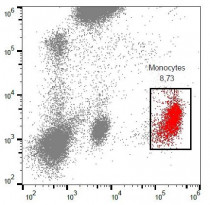
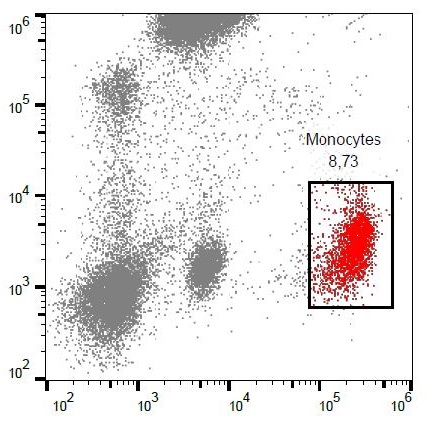
ARG53872 anti-CD53 antibody [MEM-53] (PE) FACS image
Flow Cytometry: Human peripheral blood cells stained with ARG53872 anti-CD53 antibody [MEM-53] (PE).
Clone References
Isolation of primitive endoderm, mesoderm, vascular endothelial and trophoblast progenitors from human pluripotent stem cells.


CD63 is not required for production of infectious human immunodeficiency virus type 1 in human macrophages.
ICC/IF /
In macrophages, HIV-1 assembles into an intracellular plasma membrane domain containing the tetraspanins CD81, CD9, and CD53.
ICC/IF /
CD53, a protein with four membrane-spanning domains, mediates signal transduction in human monocytes and B cells.
Cross-linking of CD53 promotes activation of resting human B lymphocytes.




