ARG53918
anti-CD99R antibody [MEM-131] (PE)
anti-CD99R antibody [MEM-131] (PE) for Flow cytometry and Human
Cancer antibody; Immune System antibody; Signaling Transduction antibody
Overview
| Product Description | PE-conjugated Mouse Monoclonal antibody [MEM-131] recognizes CD99R |
|---|---|
| Tested Reactivity | Hu |
| Tested Application | FACS |
| Specificity | The clone MEM-131 reacts with CD99R, an epitope restricted to a subset of CD99 molecule expressed on myeloid cells, NK cells and T lymphocytes. HLDA V; WS Code AS S020 HLDA V; WS Code T T-E2.02 HLDA V; WS Code T T-017 |
| Host | Mouse |
| Clonality | Monoclonal |
| Clone | MEM-131 |
| Isotype | IgM |
| Target Name | CD99R |
| Antigen Species | Human |
| Immunogen | HPB-ALL human peripheral blood leukemia T-cell line |
| Conjugation | PE |
| Alternate Names | 12E7; CD99 antigen; MIC2X; MIC2Y; CD antigen CD99; MSK5X; Protein MIC2; MIC2; T-cell surface glycoprotein E2; HBA71; E2 antigen |
Application Instructions
| Application Suggestion |
|
||||
|---|---|---|---|---|---|
| Application Note | * The dilutions indicate recommended starting dilutions and the optimal dilutions or concentrations should be determined by the scientist. |
Properties
| Form | Liquid |
|---|---|
| Purification Note | The purified antibody is conjugated with R-Phycoerythrin (PE) under optimum conditions. The conjugate is purified by size-exclusion chromatography and adjusted for direct use. No reconstitution is necessary. |
| Buffer | TBS, 15 mM Sodium azide and 0.2% (w/v) high-grade protease free BSA |
| Preservative | 15 mM Sodium azide |
| Stabilizer | 0.2% (w/v) high-grade protease free BSA |
| Storage Instruction | Aliquot and store in the dark at 2-8°C. Keep protected from prolonged exposure to light. Avoid repeated freeze/thaw cycles. Suggest spin the vial prior to opening. The antibody solution should be gently mixed before use. |
| Note | For laboratory research only, not for drug, diagnostic or other use. |
Bioinformation
| Database Links | |
|---|---|
| Gene Symbol | CD99 |
| Gene Full Name | CD99 molecule |
| Background | The protein encoded by this gene is a cell surface glycoprotein involved in leukocyte migration, T-cell adhesion, ganglioside GM1 and transmembrane protein transport, and T-cell death by a caspase-independent pathway. In addition, the encoded protein may have the ability to rearrange the actin cytoskeleton and may also act as an oncosuppressor in osteosarcoma. Cyclophilin A binds to CD99 and may act as a signaling regulator of CD99. This gene is found in the pseudoautosomal region of chromosomes X and Y and escapes X-chromosome inactivation. Three transcript variants encoding different isoforms have been found for this gene. [provided by RefSeq, Apr 2013] |
| Function | Involved in T-cell adhesion processes and in spontaneous rosette formation with erythrocytes. Plays a role in a late step of leukocyte extravasation helping leukocytes to overcome the endothelial basement membrane. Acts at the same site as, but independently of, PECAM1. Involved in T-cell adhesion processes (By similarity). [UniProt] |
| Research Area | Cancer antibody; Immune System antibody; Signaling Transduction antibody |
| Calculated MW | 19 kDa |
| PTM | Extensively O-glycosylated. |
Images (1) Click the Picture to Zoom In
-
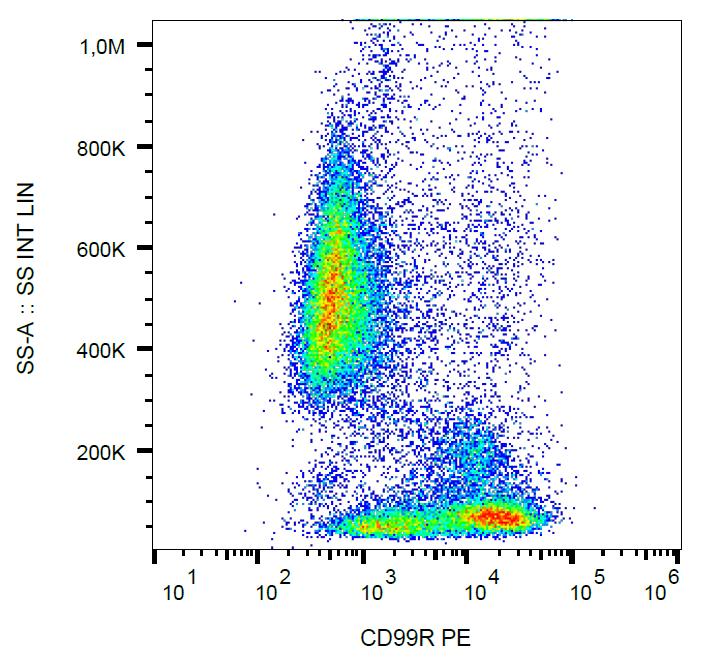
ARG53918 anti-CD99R antibody [MEM-131] (PE) FACS image
Flow Cytometry: Human peripheral blood stained with ARG53918 anti-CD99R antibody [MEM-131] (PE).