Click to copy cat No.
ARG57399
Click to copy product name
anti-CHD9 antibody
anti-CHD9 antibody for Western blot and Human,Mouse
Overview
| Product Description | Rabbit Polyclonal antibody recognizes CHD9 |
|---|---|
| Tested Reactivity | Hu, Ms |
| Tested Application | WB |
| Host | Rabbit |
| Clonality | Polyclonal |
| Isotype | IgG |
| Target Name | CHD9 |
| Antigen Species | Human |
| Immunogen | Recombinant Protein of Human CHD9. |
| Conjugation | Un-conjugated |
| Alternate Names | Chromatin-related mesenchymal modulator; KISH2; AD013; Chromodomain-helicase-DNA-binding protein 9; ATP-dependent helicase CHD9; PPAR-alpha-interacting complex protein 320 kDa; CHD-9; EC 3.6.4.12; Kismet homolog 2; CReMM; PRIC320; Chromatin-remodeling factor CHROM1; Peroxisomal proliferator-activated receptor A-interacting complex 320 kDa protein |
Application Instructions
| Application Suggestion |
|
||||
|---|---|---|---|---|---|
| Application Note | * The dilutions indicate recommended starting dilutions and the optimal dilutions or concentrations should be determined by the scientist. | ||||
| Positive Control | HeLa |
Properties
| Form | Liquid |
|---|---|
| Purification | Affinity purification with immunogen. |
| Buffer | PBS (pH 7.3), 0.02% Sodium azide and 50% Glycerol. |
| Preservative | 0.02% Sodium azide |
| Stabilizer | 50% Glycerol |
| Storage Instruction | For continuous use, store undiluted antibody at 2-8°C for up to a week. For long-term storage, aliquot and store at -20°C. Storage in frost free freezers is not recommended. Avoid repeated freeze/thaw cycles. Suggest spin the vial prior to opening. The antibody solution should be gently mixed before use. |
| Note | For laboratory research only, not for drug, diagnostic or other use. |
Bioinformation
| Database Links |
Swiss-port # Q3L8U1 Human Chromodomain-helicase-DNA-binding protein 9 Swiss-port # Q8BYH8 Mouse Chromodomain-helicase-DNA-binding protein 9 |
|---|---|
| Gene Symbol | CHD9 |
| Gene Full Name | chromodomain helicase DNA binding protein 9 |
| Function | Acts as a transcriptional coactivator for PPARA and possibly other nuclear receptors. Proposed to be a ATP-dependent chromatin remodeling protein. Has DNA-dependent ATPase activity and binds to A/T-rich DNA. Associates with A/T-rich regulatory regions in promoters of genes that participate in the differentiation of progenitors during osteogenesis (By similarity). [UniProt] |
| Calculated MW | 326 kDa |
| PTM | Phosphorylated on serine and tyrosine residues. |
Images (1) Click the Picture to Zoom In
-
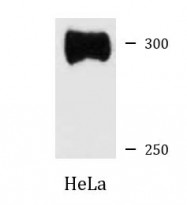
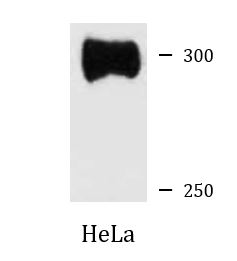
ARG57399 anti-CHD9 antibody WB image
Western blot: HeLa cell lysate stained with ARG57399 anti-CHD9 antibody.