Click to copy cat No.
ARG58407
Click to copy product name
anti-CLN5 antibody
anti-CLN5 antibody for IHC-Formalin-fixed paraffin-embedded sections,Western blot and Human,Mouse,Rat
Overview
| Product Description | Rabbit Polyclonal antibody recognizes CLN5 |
|---|---|
| Tested Reactivity | Hu, Ms, Rat |
| Tested Application | IHC-P, WB |
| Host | Rabbit |
| Clonality | Polyclonal |
| Isotype | IgG |
| Target Name | CLN5 |
| Antigen Species | Human |
| Immunogen | Recombinant fusion protein corresponding to aa. 96-407 of Human CLN5 (NP_006484.1). |
| Conjugation | Un-conjugated |
| Alternate Names | NCL; Protein CLN5; Ceroid-lipofuscinosis neuronal protein 5 |
Application Instructions
| Application Suggestion |
|
||||||
|---|---|---|---|---|---|---|---|
| Application Note | * The dilutions indicate recommended starting dilutions and the optimal dilutions or concentrations should be determined by the scientist. | ||||||
| Positive Control | Mouse heart | ||||||
| Observed Size | 50 kDa |
Properties
| Form | Liquid |
|---|---|
| Purification | Affinity purified. |
| Buffer | PBS (pH 7.3), 0.02% Sodium azide and 50% Glycerol. |
| Preservative | 0.02% Sodium azide |
| Stabilizer | 50% Glycerol |
| Storage Instruction | For continuous use, store undiluted antibody at 2-8°C for up to a week. For long-term storage, aliquot and store at -20°C. Storage in frost free freezers is not recommended. Avoid repeated freeze/thaw cycles. Suggest spin the vial prior to opening. The antibody solution should be gently mixed before use. |
| Note | For laboratory research only, not for drug, diagnostic or other use. |
Bioinformation
| Database Links |
Swiss-port # O75503 Human Ceroid-lipofuscinosis neuronal protein 5 Swiss-port # Q3UMW8 Mouse Ceroid-lipofuscinosis neuronal protein 5 homolog |
|---|---|
| Gene Symbol | CLN5 |
| Gene Full Name | ceroid-lipofuscinosis, neuronal 5 |
| Background | This gene is one of eight which have been associated with neuronal ceroid lipofuscinoses (NCL). Also referred to as Batten disease, NCL comprises a class of autosomal recessive, neurodegenerative disorders affecting children. The genes responsible likely encode proteins involved in the degradation of post-translationally modified proteins in lysosomes. The primary defect in NCL disorders is thought to be associated with lysosomal storage function.[provided by RefSeq, Oct 2008] |
| Cellular Localization | Lysosome. [UniProt] |
| Calculated MW | 41 kDa |
| PTM | N-glycosylated with both high mannose and complex type sugars. Glycosylation is important for proper folding and trafficking to the lysosomes. Ceroid-lipofuscinosis neuronal protein 5: The type II membrane signal anchor is proteolytically cleaved to produce a mature form that is transported to the lysosomes (Ceroid-lipofuscinosis neuronal protein 5, secreted form) (PubMed:24038957, PubMed:20052765). Can undergo proteolytic cleavage at the C-terminus, probably by a cysteine protease and may involve the removal of approximately 10-15 residues from the C-terminal end (PubMed:26342652). [UniProt] |
Images (1) Click the Picture to Zoom In
-
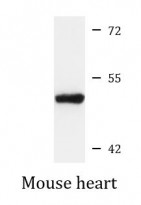
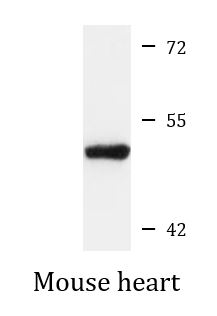
ARG58407 anti-CLN5 antibody WB image
Western blot: 25 µg of Mouse heart lysate stained with ARG58407 anti-CLN5 antibody at 1:3000 dilution.