ARG52454
anti-Cardiac Troponin I phospho (Ser150) antibody
anti-Cardiac Troponin I phospho (Ser150) antibody for Western blot and Mouse,Rat
Cell Biology and Cellular Response antibody; Controls and Markers antibody; Developmental Biology antibody; Signaling Transduction antibody
Overview
| Product Description | Rabbit Polyclonal antibody recognizes Cardiac Troponin I phospho (Ser150) |
|---|---|
| Tested Reactivity | Ms, Rat |
| Predict Reactivity | Hu, NHuPrm |
| Tested Application | WB |
| Host | Rabbit |
| Clonality | Polyclonal |
| Isotype | IgG |
| Target Name | Cardiac Troponin I |
| Antigen Species | Mouse |
| Immunogen | Synthetic phospho-peptide corresponding to amino acid residues surrounding Ser150 conjugated to KLH |
| Conjugation | Un-conjugated |
| Alternate Names | RCM1; cTnI; Cardiac troponin I; TNNC1; CMD1FF; CMD2A; Troponin I, cardiac muscle; CMH7 |
Application Instructions
| Application Suggestion |
|
||||
|---|---|---|---|---|---|
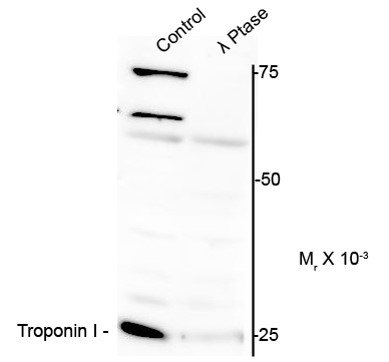
| Application Note | Specific for the ~25k cardiac troponin I protein phosphorylated at Ser150. Immunolabeling is greatly decreased with lambda-phosphatase treatment. * The dilutions indicate recommended starting dilutions and the optimal dilutions or concentrations should be determined by the scientist. |
Properties
| Form | Liquid |
|---|---|
| Purification | Affinity Purified |
| Buffer | 10 mM HEPES (pH 7.5), 150 mM NaCl, 0.1 mg/ml BSA and 50% Glycerol |
| Stabilizer | 0.1 mg/ml BSA, 50% Glycerol |
| Storage Instruction | For continuous use, store undiluted antibody at 2-8°C for up to a week. For long-term storage, aliquot and store at -20°C. Storage in frost free freezers is not recommended. Avoid repeated freeze/thaw cycles. Suggest spin the vial prior to opening. The antibody solution should be gently mixed before use. |
| Note | For laboratory research only, not for drug, diagnostic or other use. |
Bioinformation
| Database Links | |
|---|---|
| Gene Symbol | TNNI3 |
| Gene Full Name | troponin I, cardiac 3 |
| Background | Troponin I (TnI) is 1 of 3 subunits, along with troponin C (TnC) and Troponin T (TnT) of troponin complex found in cardiac (cTnI) and fast skeletal (fsTnI) muscle. cTnI is phosphorylated by protein kinase C and protein kinase A at Ser23/24 (Noland et al, 1995) and is phosphorylated by AMPK at Ser23 and Ser150 (Solis et al, 2011). Evidence suggests that AMPK, a critical regulator of cardiac energetics, prefers phosphorylating Ser150 over Ser23, and may play a role in regulating energy consumption through altering the phosphorylation status of cTnI (Solis et al., 2011). |
| Research Area | Cell Biology and Cellular Response antibody; Controls and Markers antibody; Developmental Biology antibody; Signaling Transduction antibody |
| Calculated MW | 24 kDa |
| PTM | Phosphorylated at Ser-42 and Ser-44 by PRKCE; phosphorylation increases myocardium contractile dysfunction (By similarity). Phosphorylated at Ser-23 and Ser-24 by PRKD1; phosphorylation reduces myofilament calcium sensitivity. Phosphorylated preferentially at Thr-31. Phosphorylation by STK4/MST1 alters its binding affinity to TNNC1 (cardiac Tn-C) and TNNT2 (cardiac Tn-T). |
Images (1) Click the Picture to Zoom In
-
ARG52454 anti-Cardiac Troponin I phospho (Ser150) antibody WB image
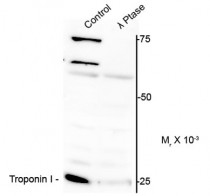
Western blot: Mouse heart lysate showing specific immunolabeling of ~25 kDa cTnI protein phosphorylated at Ser150 Phosphospecificity is shown in the second lane (lambda-phosphatase: λ-Ptase) stained with ARG52454 anti-Cardiac Troponin I phospho (Ser150) antibody.
Phosphospecificity is shown in the second lane (lambda-phosphatase: λ-Ptase).
The blot is identical to the control except that the lysate was incubated in λ-Ptase (1400 units for 30 min).
The immunolabeling is greatly decreased by treatment with λ-Ptase.
.