Click to copy cat No.
ARG42369
Click to copy product name
anti-DDIT4L antibody [DDIT-03]
anti-DDIT4L antibody [DDIT-03] for Flow cytometry,IHC-Formalin-fixed paraffin-embedded sections,Western blot and Human
Overview
| Product Description | Mouse Monoclonal antibody [DDIT-03] recognizes DDIT4L |
|---|---|
| Tested Reactivity | Hu |
| Tested Application | FACS, IHC-P, WB |
| Specificity | The mouse monoclonal antibody DDIT-03 recognizes DDIT4L / REDD2 protein, which belongs to intracellular stress-induced proteins involved in mediation of cell death. |
| Host | Mouse |
| Clonality | Monoclonal |
| Clone | DDIT-03 |
| Isotype | IgG1 |
| Target Name | DDIT4L |
| Antigen Species | Human |
| Immunogen | Recombinant fragment corresponding to aa. 2-98 of Human DDIT4L. |
| Conjugation | Un-conjugated |
| Alternate Names | REDD-2; Rtp801L; REDD2; DNA damage-inducible transcript 4-like protein; Protein regulated in development and DNA damage response 2; HIF-1 responsive protein RTP801-like |
Application Instructions
| Application Suggestion |
|
||||||||
|---|---|---|---|---|---|---|---|---|---|
| Application Note | * The dilutions indicate recommended starting dilutions and the optimal dilutions or concentrations should be determined by the scientist. |
Properties
| Form | Liquid |
|---|---|
| Purification | Purification with Protein A. |
| Buffer | PBS and 15 mM Sodium azide. |
| Preservative | 15 mM Sodium azide |
| Concentration | 1 mg/ml |
| Storage Instruction | For continuous use, store undiluted antibody at 2-8°C for up to a week. For long-term storage, aliquot and store at -20°C or below. Storage in frost free freezers is not recommended. Avoid repeated freeze/thaw cycles. Suggest spin the vial prior to opening. The antibody solution should be gently mixed before use. |
| Note | For laboratory research only, not for drug, diagnostic or other use. |
Bioinformation
| Database Links |
Swiss-port # Q96D03 Human DNA damage-inducible transcript 4-like protein |
|---|---|
| Gene Symbol | DDIT4L |
| Gene Full Name | DNA-damage-inducible transcript 4-like |
| Function | Inhibits cell growth by regulating the TOR signaling pathway upstream of the TSC1-TSC2 complex and downstream of AKT1. [UniProt] |
| Cellular Localization | Cytoplasm. [UniProt] |
| Calculated MW | 22 kDa |
Images (1) Click the Picture to Zoom In
-
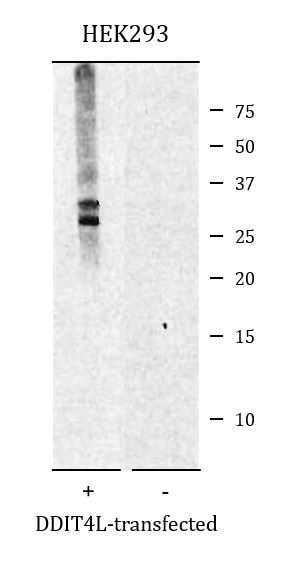
ARG42369 anti-DDIT4L antibody [DDIT-03] WB image
Western blot: DDIT4L-transfected HEK293 and non-transfected HEK293. Cell lysates were stained with ARG42369 anti-DDIT4L antibody [DDIT-03].