ARG59547
anti-E2F1 antibody
anti-E2F1 antibody for Western blot and Human
Overview
| Product Description | Rabbit Polyclonal antibody recognizes E2F1 |
|---|---|
| Tested Reactivity | Hu |
| Predict Reactivity | Hm |
| Tested Application | WB |
| Host | Rabbit |
| Clonality | Polyclonal |
| Isotype | IgG |
| Target Name | E2F1 |
| Antigen Species | Human |
| Immunogen | Synthetic peptide corresponding to aa. 246-260 of Human E2F1. (VTCQDLRSIADPAEQ) |
| Conjugation | Un-conjugated |
| Alternate Names | RBAP1; Retinoblastoma-associated protein 1; Retinoblastoma-binding protein 3; RBBP3; pRB-binding protein E2F-1; RBBP-3; E2F-1; Transcription factor E2F1; RBP3; PBR3; RBAP-1 |
Application Instructions
| Application Suggestion |
|
||||
|---|---|---|---|---|---|
| Application Note | * The dilutions indicate recommended starting dilutions and the optimal dilutions or concentrations should be determined by the scientist. |
Properties
| Form | Liquid |
|---|---|
| Purification | Affinity purification with immunogen. |
| Buffer | 0.9% NaCl, 0.2% Na2HPO4, 0.05% Thimerosal, 0.05% Sodium azide and 5% BSA. |
| Preservative | 0.05% Thimerosal and 0.05% Sodium azide |
| Stabilizer | 5% BSA |
| Concentration | 0.5 mg/ml |
| Storage Instruction | For continuous use, store undiluted antibody at 2-8°C for up to a week. For long-term storage, aliquot and store at -20°C or below. Storage in frost free freezers is not recommended. Avoid repeated freeze/thaw cycles. Suggest spin the vial prior to opening. The antibody solution should be gently mixed before use. |
| Note | For laboratory research only, not for drug, diagnostic or other use. |
Bioinformation
| Database Links | |
|---|---|
| Gene Symbol | E2F1 |
| Gene Full Name | E2F transcription factor 1 |
| Background | The protein encoded by this gene is a member of the E2F family of transcription factors. The E2F family plays a crucial role in the control of cell cycle and action of tumor suppressor proteins and is also a target of the transforming proteins of small DNA tumor viruses. The E2F proteins contain several evolutionally conserved domains found in most members of the family. These domains include a DNA binding domain, a dimerization domain which determines interaction with the differentiation regulated transcription factor proteins (DP), a transactivation domain enriched in acidic amino acids, and a tumor suppressor protein association domain which is embedded within the transactivation domain. This protein and another 2 members, E2F2 and E2F3, have an additional cyclin binding domain. This protein binds preferentially to retinoblastoma protein pRB in a cell-cycle dependent manner. It can mediate both cell proliferation and p53-dependent/independent apoptosis. [provided by RefSeq, Jul 2008] |
| Function | Transcription activator that binds DNA cooperatively with DP proteins through the E2 recognition site, 5'-TTTC[CG]CGC-3' found in the promoter region of a number of genes whose products are involved in cell cycle regulation or in DNA replication. The DRTF1/E2F complex functions in the control of cell-cycle progression from G1 to S phase. E2F1 binds preferentially RB1 in a cell-cycle dependent manner. It can mediate both cell proliferation and TP53/p53-dependent apoptosis. Blocks adipocyte differentiation by binding to specific promoters repressing CEBPA binding to its target gene promoters. [UniProt] |
| Cellular Localization | Nucleus. [UniProt] |
| Calculated MW | 47 kDa |
| PTM | Phosphorylated by CDK2 and cyclin A-CDK2 in the S-phase. Phosphorylation at Ser-364 by CHEK2 stabilizes E2F1 upon DNA damage and regulates its effect on transcription and apoptosis. Acetylation stimulates DNA-binding. Enhanced under stress conditions such as DNA damage and inhibited by retinoblastoma protein RB1. Regulated by KAP1/TRIM28 which recruits HDAC1 to E2F1 resulting in deacetylation. Acetylated by P/CAF/KAT2B. [UniProt] |
Images (1) Click the Picture to Zoom In
-
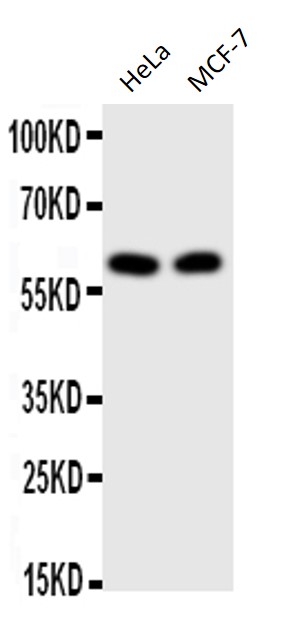
ARG59547 anti-E2F1 antibody WB image
Western blot: 40 µg of HeLa and MCF-7 whole cell lysates stained with ARG59547 anti-E2F1 antibody at 0.5 µg/ml dilution.