Click to copy cat No.
ARG59966
Click to copy product name
anti-Eotaxin antibody
anti-Eotaxin antibody for ICC/IF,Western blot and Human,Mouse,Rat
Overview
| Product Description | Rabbit Polyclonal antibody recognizes Eotaxin |
|---|---|
| Tested Reactivity | Hu, Ms, Rat |
| Tested Application | ICC/IF, WB |
| Host | Rabbit |
| Clonality | Polyclonal |
| Isotype | IgG |
| Target Name | Eotaxin |
| Antigen Species | Human |
| Immunogen | Recombinant fusion protein corresponding to aa. 1-97 of Human Eotaxin (NP_002977.1). |
| Conjugation | Un-conjugated |
| Alternate Names | SCYA11; C-C motif chemokine 11; Eosinophil chemotactic protein; Eotaxin; Small-inducible cytokine A11 |
Application Instructions
| Application Suggestion |
|
||||||
|---|---|---|---|---|---|---|---|
| Application Note | * The dilutions indicate recommended starting dilutions and the optimal dilutions or concentrations should be determined by the scientist. | ||||||
| Observed Size | 20 kDa |
Properties
| Form | Liquid |
|---|---|
| Purification | Affinity purified. |
| Buffer | PBS (pH 7.3), 0.02% Sodium azide and 50% Glycerol. |
| Preservative | 0.02% Sodium azide |
| Stabilizer | 50% Glycerol |
| Storage Instruction | For continuous use, store undiluted antibody at 2-8°C for up to a week. For long-term storage, aliquot and store at -20°C. Storage in frost free freezers is not recommended. Avoid repeated freeze/thaw cycles. Suggest spin the vial prior to opening. The antibody solution should be gently mixed before use. |
| Note | For laboratory research only, not for drug, diagnostic or other use. |
Bioinformation
| Database Links | |
|---|---|
| Gene Symbol | CCL11 |
| Gene Full Name | chemokine (C-C motif) ligand 11 |
| Background | This antimicrobial gene is one of several chemokine genes clustered on the q-arm of chromosome 17. Chemokines form a superfamily of secreted proteins involved in immunoregulatory and inflammatory processes. The superfamily is divided into four subfamilies based on the arrangement of the N-terminal cysteine residues of the mature peptide. This chemokine, a member of the CC subfamily, displays chemotactic activity for eosinophils, but not mononuclear cells or neutrophils. This eosinophil-specific chemokine is thought to be involved in eosinophilic inflammatory diseases such as atopic dermatitis, allergic rhinitis, asthma and parasitic infections. [provided by RefSeq, Sep 2014] |
| Function | In response to the presence of allergens, this protein directly promotes the accumulation of eosinophils, a prominent feature of allergic inflammatory reactions. Binds to CCR3. [UniProt] |
| Cellular Localization | Secreted. [UniProt] |
| Calculated MW | 11 kDa |
| PTM | O-linked glycan consists of a Gal-GalNAc disaccharide which is modified with up to 2 sialic acid residues. [UniProt] |
Images (1) Click the Picture to Zoom In
-
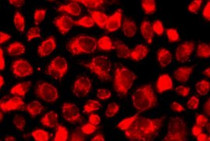
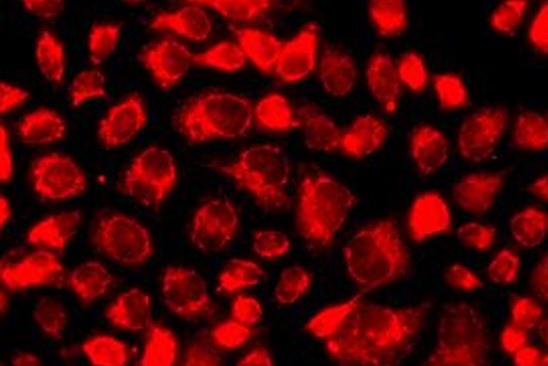
ARG59966 anti-Eotaxin antibody ICC/IF image
Immunofluorescence: A549 cells stained with ARG59966 anti-Eotaxin antibody.