ARG53829
anti-EpCAM antibody [VU-1D9] (PE)
anti-EpCAM antibody [VU-1D9] (PE) for Flow cytometry and Human
Controls and Markers antibody; Epithelial Marker antibody; Circulating Tumor Cells BioMarker antibody
Overview
| Product Description | PE-conjugated Mouse Monoclonal antibody [VU-1D9] recognizes CD326 / EpCAM |
|---|---|
| Tested Reactivity | Hu |
| Tested Application | FACS |
| Specificity | The clone VU-1D9 recognizes an epitope within EGF-like domain I of CD326 / EpCAM, a marker of epithelial lineages. This antibody strongly stains various normal epithelial cells and carcinomas. |
| Host | Mouse |
| Clonality | Monoclonal |
| Clone | VU-1D9 |
| Isotype | IgG1 |
| Target Name | EpCAM |
| Immunogen | Small cell lung carcinoma cell line H69. |
| Conjugation | PE |
| Alternate Names | MIC18; EGP; Tumor-associated calcium signal transducer 1; Epithelial glycoprotein 314; KSA; Ep-CAM; Epithelial cell surface antigen; Adenocarcinoma-associated antigen; HNPCC8; Cell surface glycoprotein Trop-1; EGP40; TACSTD1; KS1/4; hEGP314; Major gastrointestinal tumor-associated protein GA733-2; M4S1; MK-1; Epithelial glycoprotein; KS 1/4 antigen; ESA; DIAR5; EGP314; Epithelial cell adhesion molecule; EGP-2; TROP1; CD antigen CD326 |
Application Instructions
| Application Suggestion |
|
||||
|---|---|---|---|---|---|
| Application Note | * The dilutions indicate recommended starting dilutions and the optimal dilutions or concentrations should be determined by the scientist. |
Properties
| Form | Liquid |
|---|---|
| Purification Note | The purified antibody is conjugated with R-Phycoerythrin (PE) under optimum conditions. The conjugate is purified by size-exclusion chromatography and adjusted for direct use. No reconstitution is necessary. |
| Buffer | PBS, 15 mM Sodium azide and 0.2% (w/v) high-grade protease free BSA |
| Preservative | 15 mM Sodium azide |
| Stabilizer | 0.2% (w/v) high-grade protease free BSA |
| Storage Instruction | Aliquot and store in the dark at 2-8°C. Keep protected from prolonged exposure to light. Avoid repeated freeze/thaw cycles. Suggest spin the vial prior to opening. The antibody solution should be gently mixed before use. |
| Note | For laboratory research only, not for drug, diagnostic or other use. |
Bioinformation
| Database Links | |
|---|---|
| Gene Symbol | EPCAM |
| Gene Full Name | epithelial cell adhesion molecule |
| Background | EpCAM is a carcinoma-associated antigen and is a member of a family that includes at least two type I membrane proteins. This antigen is expressed on most normal epithelial cells and gastrointestinal carcinomas and functions as a homotypic calcium-independent cell adhesion molecule. The antigen is being used as a target for immunotherapy treatment of human carcinomas. Mutations in this gene result in congenital tufting enteropathy. [provided by RefSeq, Dec 2008] |
| Function | EpCAM may act as a physical homophilic interaction molecule between intestinal epithelial cells (IECs) and intraepithelial lymphocytes (IELs) at the mucosal epithelium for providing immunological barrier as a first line of defense against mucosal infection. Plays a role in embryonic stem cells proliferation and differentiation. Up-regulates the expression of FABP5, MYC and cyclins A and E. [UniProt] |
| Research Area | Controls and Markers antibody; Epithelial Marker antibody; Circulating Tumor Cells BioMarker antibody |
| Calculated MW | 35 kDa |
| PTM | Hyperglycosylated in carcinoma tissue as compared with autologous normal epithelia. Glycosylation at Asn-198 is crucial for protein stability. |
Images (1) Click the Picture to Zoom In
-
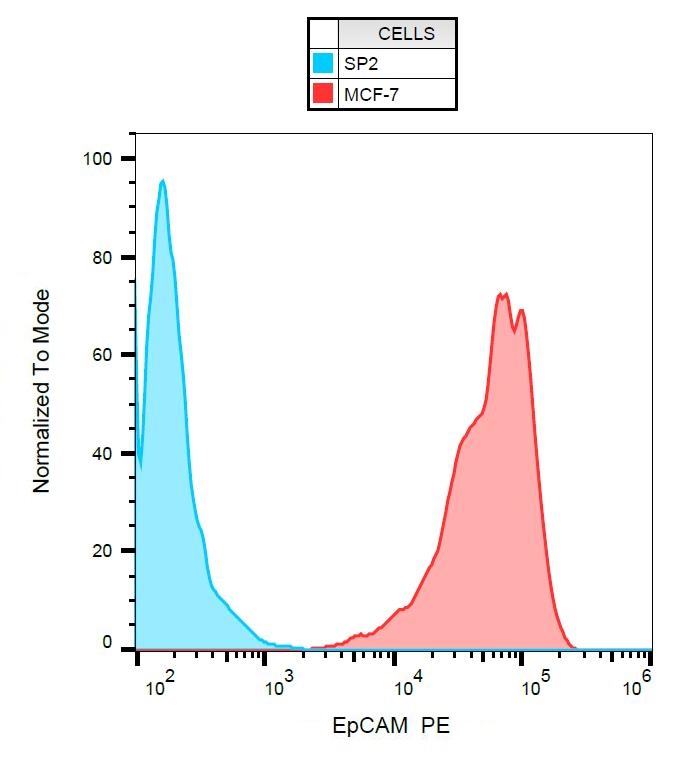
ARG53829 anti-EpCAM antibody [VU-1D9] (PE) FACS image
Flow Cytometry: MCF-7 cells stained with ARG53829 anti-EpCAM antibody [VU-1D9] (PE).
Clone References
Superficial scrapings from breast tumors is a source for biobanking and research purposes.


Multiple breast cancer cell-lines derived from a single tumor differ in their molecular characteristics and tumorigenic potential.
FACS / Human
Differential gene expression in normal esophagus and Barrett's esophagus.
IHC / Human
Heritable somatic methylation and inactivation of MSH2 in families with Lynch syndrome due to deletion of the 3' exons of TACSTD1.
IHC / Human
EpCAM is predominantly expressed in high grade and advanced stage urothelial carcinoma of the bladder.
Molecular and prognostic distinction between serous ovarian carcinomas of varying grade and malignant potential.
IHC / Human




