Click to copy cat No.
ARG54167
Click to copy product name
anti-FEN1 antibody
anti-FEN1 antibody for ICC/IF,Western blot and Human,Mouse,Rat,Hamster,Monkey
Gene Regulation antibody
Overview
| Product Description | Mouse Monoclonal antibody recognizes FEN1 |
|---|---|
| Tested Reactivity | Hu, Ms, Rat, Hm, Mk |
| Tested Application | ICC/IF, WB |
| Host | Mouse |
| Clonality | Monoclonal |
| Isotype | IgG1 |
| Target Name | FEN1 |
| Antigen Species | Human |
| Immunogen | Purified recombinant human FEN-1 protein fragments expressed in E.coli. |
| Conjugation | Un-conjugated |
| Alternate Names | hFEN-1; Maturation factor 1; Flap endonuclease 1; DNase IV; EC 3.1.-.-; FEN-1; MF1; Flap structure-specific endonuclease 1; RAD2 |
Application Instructions
| Application Suggestion |
|
||||||
|---|---|---|---|---|---|---|---|
| Application Note | * The dilutions indicate recommended starting dilutions and the optimal dilutions or concentrations should be determined by the scientist. | ||||||
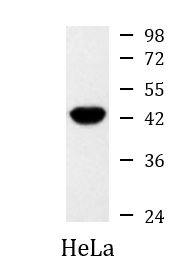
| Observed Size | 45 kDa |
Properties
| Form | Liquid |
|---|---|
| Purification | Affinity purified |
| Buffer | PBS (pH 7.4), 0.02% Sodium azide and 50% Glycerol |
| Preservative | 0.02% Sodium azide |
| Stabilizer | 50% Glycerol |
| Concentration | 1.5 mg/ml |
| Storage Instruction | For continuous use, store undiluted antibody at 2-8°C for up to a week. For long-term storage, aliquot and store at -20°C. Storage in frost free freezers is not recommended. Avoid repeated freeze/thaw cycles. Suggest spin the vial prior to opening. The antibody solution should be gently mixed before use. |
| Note | For laboratory research only, not for drug, diagnostic or other use. |
Bioinformation
| Database Links | |
|---|---|
| Gene Symbol | FEN1 |
| Gene Full Name | flap structure-specific endonuclease 1 |
| Background | Structure-specific nuclease with 5'-flap endonuclease and 5'-3' exonuclease activities involved in DNA replication and repair.During DNA replication,cleaves the 5'-overhanging flap structure that is generated by displacement synthesis when DNA polymerase encounters the 5'-end of a downstream Okazaki fragment.It enters the flap from the 5'-end and then tracks to cleave the flap base,leaving a nick for ligation.Also involved in the long patch base excision repair (LP-BER) pathway,by cleaving within the apurinic/apyrimidinic (AP) site-terminated flap.Acts as a genome stabilization factor that prevents flaps from equilibrating into structurs that lead to duplications and deletions.Also possesses 5'-3' exonuclease activity on nicked or gapped double-stranded DNA,and exhibits RNase H activity.Also involved in replication and repair of rDNA and in repairing mitochondrial DNA. |
| Function | Structure-specific nuclease with 5'-flap endonuclease and 5'-3' exonuclease activities involved in DNA replication and repair. During DNA replication, cleaves the 5'-overhanging flap structure that is generated by displacement synthesis when DNA polymerase encounters the 5'-end of a downstream Okazaki fragment. It enters the flap from the 5'-end and then tracks to cleave the flap base, leaving a nick for ligation. Also involved in the long patch base excision repair (LP-BER) pathway, by cleaving within the apurinic/apyrimidinic (AP) site-terminated flap. Acts as a genome stabilization factor that prevents flaps from equilibrating into structurs that lead to duplications and deletions. Also possesses 5'-3' exonuclease activity on nicked or gapped double-stranded DNA, and exhibits RNase H activity. Also involved in replication and repair of rDNA and in repairing mitochondrial DNA. [UniProt] |
| Cellular Localization | Isoform 1: Nucleus > nucleolus. Nucleus > nucleoplasm. Note: Resides mostly in the nucleoli and relocalizes to the nucleoplasm upon DNA damage. Isoform FENMIT: Mitochondrion. |
| Research Area | Gene Regulation antibody |
| Calculated MW | 43 kDa |
| PTM | Acetylated by EP300. Acetylation inhibits both endonuclease and exonuclease activity. Acetylation also reduces DNA-binding activity but does not affect interaction with PCNA or EP300. Phosphorylation upon DNA damage induces relocalization to the nuclear plasma. Phosphorylation at Ser-187 by CDK2 occurs during late S-phase and results in dissociation from PCNA. Methylation at Arg-192 by PRMT5 impedes Ser-187 phosphorylation and increases interaction with PCNA. |
Images (2) Click the Picture to Zoom In
-
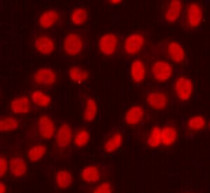
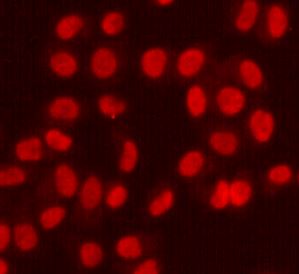
ARG54167 anti-FEN1 antibody ICC/IF image
Immunofluorescence: HeLa cells fixed with 4% Paraformaldehyde and stained with ARG54167 anti-FEN1 antibody at 1:400 dilution.
-
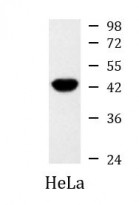
ARG54167 anti-FEN1 antibody WB image
Western blot: HeLa cell lysate stained with ARG54167 anti-FEN1 antibody at 1:1000 dilution.