ARG66497
anti-GLUT1 antibody
anti-GLUT1 antibody for IHC-Formalin-fixed paraffin-embedded sections and Human
Overview
| Product Description | Mouse Monoclonal antibody recognizes GLUT1 |
|---|---|
| Tested Reactivity | Hu |
| Tested Application | IHC-P |
| Host | Mouse |
| Clonality | Monoclonal |
| Isotype | IgG2a, kappa |
| Target Name | GLUT1 |
| Antigen Species | Human |
| Immunogen | Synthetic peptide derived from Human GLUT1. |
| Conjugation | Un-conjugated |
| Alternate Names | DYT17; HepG2 glucose transporter; CSE; GLUT-1; GLUT; GLUT1DS; DYT18; HTLVR; PED; Glucose transporter type 1, erythrocyte/brain; DYT9; EIG12; GLUT1; Solute carrier family 2, facilitated glucose transporter member 1 |
Application Instructions
| Application Suggestion |
|
||||
|---|---|---|---|---|---|
| Application Note | IHC-P: Antigen Retrieval: Tris/EDTA buffer (pH 8.0) was used. * The dilutions indicate recommended starting dilutions and the optimal dilutions or concentrations should be determined by the scientist. |
Properties
| Form | Liquid |
|---|---|
| Purification | Affinity purification with immunogen. |
| Buffer | PBS, 0.02% Sodium azide, 50% Glycerol and 0.5% BSA. |
| Preservative | 0.02% Sodium azide |
| Stabilizer | 50% Glycerol and 0.5% BSA |
| Concentration | 1 mg/ml |
| Storage Instruction | For continuous use, store undiluted antibody at 2-8°C for up to a week. For long-term storage, aliquot and store at -20°C. Storage in frost free freezers is not recommended. Avoid repeated freeze/thaw cycles. Suggest spin the vial prior to opening. The antibody solution should be gently mixed before use. |
| Note | For laboratory research only, not for drug, diagnostic or other use. |
Bioinformation
| Database Links |
Swiss-port # P11166 Human Solute carrier family 2, facilitated glucose transporter member 1 |
|---|---|
| Gene Symbol | SLC2A1 |
| Gene Full Name | solute carrier family 2 (facilitated glucose transporter), member 1 |
| Background | This gene encodes a major glucose transporter in the mammalian blood-brain barrier. The encoded protein is found primarily in the cell membrane and on the cell surface, where it can also function as a receptor for human T-cell leukemia virus (HTLV) I and II. Mutations in this gene have been found in a family with paroxysmal exertion-induced dyskinesia. [provided by RefSeq, Apr 2013] |
| Function | Facilitative glucose transporter. This isoform may be responsible for constitutive or basal glucose uptake. Has a very broad substrate specificity; can transport a wide range of aldoses including both pentoses and hexoses. [UniProt] |
| Cellular Localization | Cell membrane; Multi-pass membrane protein. Melanosome. Note=Localizes primarily at the cell surface. Identified by mass spectrometry in melanosome fractions from stage I to stage IV. [UniProt] |
| Calculated MW | 54 kDa |
Images (1) Click the Picture to Zoom In
-
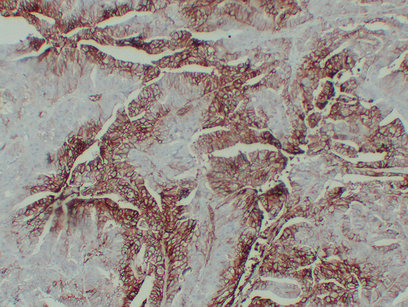
ARG66497 anti-GLUT1 antibody IHC-P image
Immunohistochemistry: Paraffin-embedded Human colon carcinoma stained with ARG66497 anti-GLUT1 antibody at 1:200 (4°C, overnight). Antigen Retrieval: Tris/EDTA buffer (pH 8.0) was used.