ARG56351
anti-GTF2H3 antibody
anti-GTF2H3 antibody for Immunoprecipitation,Western blot and Human,Mouse
Overview
| Product Description | Rabbit Polyclonal antibody recognizes GTF2H3 |
|---|---|
| Tested Reactivity | Hu, Ms |
| Tested Application | IP, WB |
| Host | Rabbit |
| Clonality | Polyclonal |
| Isotype | IgG |
| Target Name | GTF2H3 |
| Antigen Species | Human |
| Immunogen | Recombinant protein of Human GTF2H3 |
| Conjugation | Un-conjugated |
| Alternate Names | BTF2 p34; BTF2; General transcription factor IIH polypeptide 3; General transcription factor IIH subunit 3; Basic transcription factor 2 34 kDa subunit; TFB4; TFIIH; TFIIH basal transcription factor complex p34 subunit; P34 |
Application Instructions
| Application Suggestion |
|
||||||
|---|---|---|---|---|---|---|---|
| Application Note | * The dilutions indicate recommended starting dilutions and the optimal dilutions or concentrations should be determined by the scientist. | ||||||
| Positive Control | MCF7 |
Properties
| Form | Liquid |
|---|---|
| Purification | Affinity purification with immunogen. |
| Buffer | PBS (pH 7.3), 0.02% Sodium azide and 50% Glycerol. |
| Preservative | 0.02% Sodium azide |
| Stabilizer | 50% Glycerol |
| Storage Instruction | For continuous use, store undiluted antibody at 2-8°C for up to a week. For long-term storage, aliquot and store at -20°C. Storage in frost free freezers is not recommended. Avoid repeated freeze/thaw cycles. Suggest spin the vial prior to opening. The antibody solution should be gently mixed before use. |
| Note | For laboratory research only, not for drug, diagnostic or other use. |
Bioinformation
| Database Links |
Swiss-port # Q13889 Human General transcription factor IIH subunit 3 Swiss-port # Q8VD76 Mouse General transcription factor IIH subunit 3 |
|---|---|
| Gene Symbol | GTF2H3 |
| Gene Full Name | general transcription factor IIH, polypeptide 3, 34kDa |
| Background | This gene encodes a member of the TFB4 family. The encoded protein is a subunit of the core-TFIIH basal transcription factor and localizes to the nucleus. The encoded protein is involved in RNA transcription by RNA polymerase II and nucleotide excision repair and associates with the Cdk-activating kinase complex. Alternative splicing results in multiple transcript variants. A related pseudogene has been identified on chromosome 14. [provided by RefSeq, Dec 2012] |
| Function | Component of the core-TFIIH basal transcription factor involved in nucleotide excision repair (NER) of DNA and, when complexed to CAK, in RNA transcription by RNA polymerase II. Anchors XPB. [UniProt] |
| Calculated MW | 34 kDa |
Images (1) Click the Picture to Zoom In
-
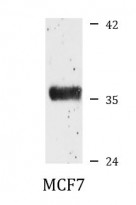
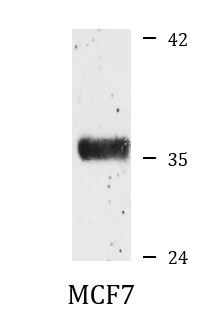
ARG56351 anti-GTF2H3 antibody WB image
Western blot: MCF7 cell lysate stained with ARG56351 anti-GTF2H3 antibody.