Click to copy cat No.
ARG54183
Click to copy product name
anti-Hsp 90 alpha antibody
anti-Hsp 90 alpha antibody for Western blot and Human,Mouse,Rat,Monkey
Cancer antibody; Signaling Transduction antibody
Overview
| Product Description | Mouse Monoclonal antibody recognizes Hsp 90 alpha |
|---|---|
| Tested Reactivity | Hu, Ms, Rat, Mk |
| Tested Application | WB |
| Host | Mouse |
| Clonality | Monoclonal |
| Isotype | IgG1 |
| Target Name | Hsp 90 alpha |
| Antigen Species | Human |
| Immunogen | Purified recombinant human Hsp90 alpha protein fragments expressed in E.coli |
| Conjugation | Un-conjugated |
| Alternate Names | EL52; Hsp90; HSPC1; Heat shock 86 kDa; LAP-2; HSP90N; LAP2; HSP90A; HSPCAL4; HSP89A; HSP86; HSP 86; HSPCA; Lipopolysaccharide-associated protein 2; HSPCAL1; LPS-associated protein 2; HSPN; Renal carcinoma antigen NY-REN-38; Heat shock protein HSP 90-alpha; Hsp89 |
Application Instructions
| Application Suggestion |
|
||||
|---|---|---|---|---|---|
| Application Note | * The dilutions indicate recommended starting dilutions and the optimal dilutions or concentrations should be determined by the scientist. | ||||
| Observed Size | 90 kDa |
Properties
| Form | Liquid |
|---|---|
| Purification | Affinity purified |
| Buffer | PBS (pH 7.4), 0.02% Sodium azide, 1mg/ml BSA and 50% Glycerol |
| Preservative | 0.02% Sodium azide |
| Stabilizer | 1mg/ml BSA, 50% Glycerol |
| Concentration | 0.6 mg/ml |
| Storage Instruction | For continuous use, store undiluted antibody at 2-8°C for up to a week. For long-term storage, aliquot and store at -20°C. Storage in frost free freezers is not recommended. Avoid repeated freeze/thaw cycles. Suggest spin the vial prior to opening. The antibody solution should be gently mixed before use. |
| Note | For laboratory research only, not for drug, diagnostic or other use. |
Bioinformation
| Database Links | |
|---|---|
| Gene Symbol | HSP90AA1 |
| Gene Full Name | heat shock protein 90kDa alpha (cytosolic), class A member 1 |
| Background | Molecular chaperone that promotes the maturation, structural maintenance and proper regulation of specific target proteins involved for instance in cell cycle control and signal transduction. Undergoes a functional cycle that is linked to its ATPase activity. This cycle probably induces conformational changes in the client proteins, thereby causing their activation. Interacts dynamically with various co-chaperones that modulate its substrate recognition, ATPase cycle and chaperone function. Binds bacterial lipopolysaccharide (LPS) et mediates LPS-induced inflammatory response, including TNF secretion by monocytes. |
| Function | Molecular chaperone that promotes the maturation, structural maintenance and proper regulation of specific target proteins involved for instance in cell cycle control and signal transduction. Undergoes a functional cycle that is linked to its ATPase activity. This cycle probably induces conformational changes in the client proteins, thereby causing their activation. Interacts dynamically with various co-chaperones that modulate its substrate recognition, ATPase cycle and chaperone function. Binds bacterial lipopolysaccharide (LPS) et mediates LPS-induced inflammatory response, including TNF secretion by monocytes. [UniProt] |
| Cellular Localization | Cytoplasm. Melanosome. Cell membrane. |
| Research Area | Cancer antibody; Signaling Transduction antibody |
| Calculated MW | 85 kDa |
| PTM | ISGylated. S-nitrosylated; negatively regulates the ATPase activity and the activation of eNOS by HSP90AA1. |
Images (1) Click the Picture to Zoom In
-
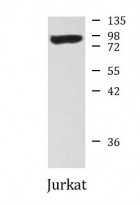
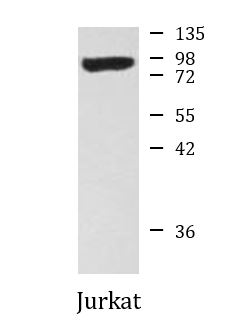
ARG54183 anti-Hsp 90 alpha antibody WB image
Western blot: Jurkat cell lysate stained with ARG54183 anti-Hsp 90 alpha antibody at 1:1000 dilution.