Click to copy cat No.
ARG41539
Click to copy product name
anti-LOX antibody
anti-LOX antibody for Flow cytometry,ICC/IF,IHC-Formalin-fixed paraffin-embedded sections,Immunoprecipitation,Western blot and Human,Mouse,Rat
Overview
| Product Description | Rabbit Polyclonal antibody recognizes LOX |
|---|---|
| Tested Reactivity | Hu, Ms, Rat |
| Tested Application | FACS, ICC/IF, IHC-P, IP, WB |
| Host | Rabbit |
| Clonality | Polyclonal |
| Isotype | IgG |
| Target Name | LOX |
| Antigen Species | Human |
| Immunogen | Synthetic peptide of Human LOX. |
| Conjugation | Un-conjugated |
| Alternate Names | Lysyl oxidase; EC 1.4.3.13; Protein-lysine 6-oxidase |
Application Instructions
| Application Suggestion |
|
||||||||||||
|---|---|---|---|---|---|---|---|---|---|---|---|---|---|
| Application Note | * The dilutions indicate recommended starting dilutions and the optimal dilutions or concentrations should be determined by the scientist. | ||||||||||||
| Positive Control | Jurkat | ||||||||||||
| Observed Size | ~ 50 kDa |
Properties
| Form | Liquid |
|---|---|
| Purification | Affinity purified. |
| Buffer | PBS (pH 7.4), 150 mM NaCl, 0.02% Sodium azide and 50% Glycerol. |
| Preservative | 0.02% Sodium azide |
| Stabilizer | 50% Glycerol |
| Storage Instruction | For continuous use, store undiluted antibody at 2-8°C for up to a week. For long-term storage, aliquot and store at -20°C. Storage in frost free freezers is not recommended. Avoid repeated freeze/thaw cycles. Suggest spin the vial prior to opening. The antibody solution should be gently mixed before use. |
| Note | For laboratory research only, not for drug, diagnostic or other use. |
Bioinformation
| Database Links | |
|---|---|
| Gene Symbol | LOX |
| Gene Full Name | lysyl oxidase |
| Background | The protein encoded by this gene is an extracellular copper enzyme that initiates the crosslinking of collagens and elastin. The enzyme catalyzes oxidative deamination of the epsilon-amino group in certain lysine and hydroxylysine residues of collagens and lysine residues of elastin. In addition to crosslinking extracellular matrix proteins, the encoded protein may have a role in tumor suppression. Defects in this gene are a cause of autosomal recessive cutis laxa type I (CL type I). Two transcript variants encoding different isoforms have been found for this gene. [provided by RefSeq, May 2010] |
| Function | Responsible for the post-translational oxidative deamination of peptidyl lysine residues in precursors to fibrous collagen and elastin. In addition to cross-linking of extracellular matrix proteins, may have a direct role in tumor suppression. [UniProt] |
| Cellular Localization | Secreted. Secreted, extracellular space. [UniProt] |
| Calculated MW | 47 kDa |
| PTM | The lysine tyrosylquinone cross-link (LTQ) is generated by condensation of the epsilon-amino group of a lysine with a topaquinone produced by oxidation of tyrosine. Proteolytically activated by BMP1. [UniProt] |
Images (3) Click the Picture to Zoom In
-
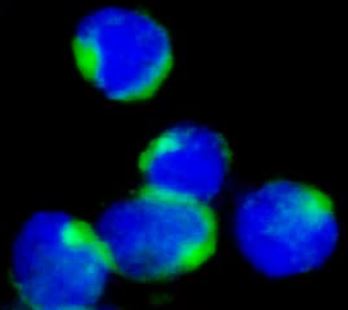
ARG41539 anti-LOX antibody ICC/IF image
Immunofluorescence: Jurkat cells stained with ARG41539 anti-LOX antibody (green).
-
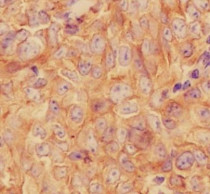
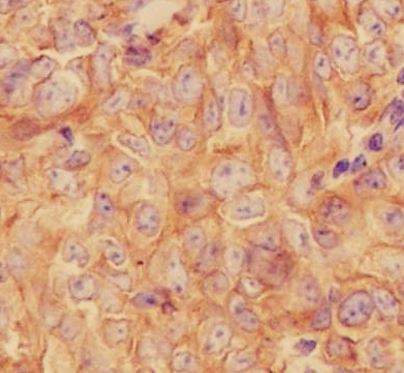
ARG41539 anti-LOX antibody IHC-P image
Immunohistochemistry: Paraffin-embedded Human breast tissue stained with ARG41539 anti-LOX antibody.
-
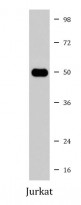
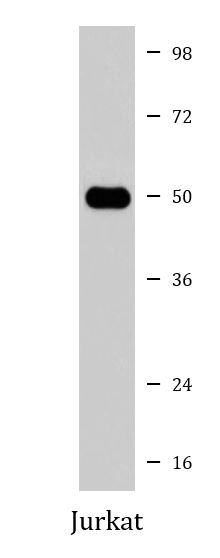
ARG41539 anti-LOX antibody WB image
Western blot: Jurkat cell lysate stained with ARG41539 anti-LOX antibody.