Click to copy cat No.
ARG58833
Click to copy product name
anti-LOXL2 antibody
anti-LOXL2 antibody for Western blot and Human,Mouse,Rat
Overview
| Product Description | Rabbit Polyclonal antibody recognizes LOXL2 |
|---|---|
| Tested Reactivity | Hu, Ms, Rat |
| Predict Reactivity | Bov |
| Tested Application | WB |
| Host | Rabbit |
| Clonality | Polyclonal |
| Isotype | IgG |
| Target Name | LOXL2 |
| Antigen Species | Human |
| Immunogen | Synthetic peptide corresponding to aa. 739-770 of Human LOXL2 (HRIWMYNCHIGGSFSEETEKKFEHFSGLLNNQ). |
| Conjugation | Un-conjugated |
| Alternate Names | Lysyl oxidase-related protein 2; Lysyl oxidase-related protein WS9-14; LOR2; Lysyl oxidase-like protein 2; Lysyl oxidase homolog 2; EC 1.4.3.13; WS9-14 |
Application Instructions
| Application Suggestion |
|
||||
|---|---|---|---|---|---|
| Application Note | * The dilutions indicate recommended starting dilutions and the optimal dilutions or concentrations should be determined by the scientist. |
Properties
| Form | Liquid |
|---|---|
| Purification | Affinity purification with immunogen. |
| Buffer | 0.9% NaCl, 0.2% Na2HPO4, 0.05% Sodium azide and 5% BSA. |
| Preservative | 0.05% Sodium azide |
| Stabilizer | 5% BSA |
| Concentration | 0.5 mg/ml |
| Storage Instruction | For continuous use, store undiluted antibody at 2-8°C for up to a week. For long-term storage, aliquot and store at -20°C or below. Storage in frost free freezers is not recommended. Avoid repeated freeze/thaw cycles. Suggest spin the vial prior to opening. The antibody solution should be gently mixed before use. |
| Note | For laboratory research only, not for drug, diagnostic or other use. |
Bioinformation
| Database Links | |
|---|---|
| Gene Symbol | LOXL2 |
| Gene Full Name | lysyl oxidase-like 2 |
| Background | This gene encodes a member of the lysyl oxidase gene family. The prototypic member of the family is essential to the biogenesis of connective tissue, encoding an extracellular copper-dependent amine oxidase that catalyses the first step in the formation of crosslinks in collagens and elastin. A highly conserved amino acid sequence at the C-terminus end appears to be sufficient for amine oxidase activity, suggesting that each family member may retain this function. The N-terminus is poorly conserved and may impart additional roles in developmental regulation, senescence, tumor suppression, cell growth control, and chemotaxis to each member of the family. [provided by RefSeq, Jul 2008] |
| Function | Mediates the post-translational oxidative deamination of lysine residues on target proteins leading to the formation of deaminated lysine (allysine). When secreted in extracellular matrix, promotes cross-linking of extracellular matrix proteins by mediating oxidative deamination of peptidyl lysine residues in precursors to fibrous collagen and elastin. Acts as a regulator of sprouting angiogenesis, probably via collagen IV scaffolding. When nuclear, acts as a transcription corepressor and specifically mediates deamination of trimethylated 'Lys-4' of histone H3 (H3K4me3), a specific tag for epigenetic transcriptional activation. Involved in epithelial to mesenchymal transition (EMT) via interaction with SNAI1 and participates in repression of E-cadherin, probably by mediating deamination of histone H3. Also involved in E-cadherin repression following hypoxia, a hallmark of epithelial to mesenchymal transition believed to amplify tumor aggressiveness, suggesting that it may play a role in tumor progression. Acts as a regulator of chondrocyte differentiation, probably by regulating expression of factors that control chondrocyte differentiation. [UniProt] |
| Cellular Localization | Secreted, extracellular space, extracellular matrix, basement membrane. Nucleus. Chromosome. Associated with chromatin. It is unclear how LOXL2 is nuclear: it contains a clear signal sequence and is predicted to localize in the extracellular medium. However, different reports confirmed the intracellular location and its key role in transcription regulation. [UniProt] |
| Calculated MW | 87 kDa |
| PTM | The lysine tyrosylquinone cross-link (LTQ) is generated by condensation of the epsilon-amino group of a lysine with a topaquinone produced by oxidation of tyrosine. N-glycosylated. N-glycosylation on Asn-455 and Asn-644 may be essential for proper folding and secretion; may be composed of a fucosylated carbohydrates attached to a trimannose N-linked glycan core. [UniProt] |
Images (1) Click the Picture to Zoom In
-
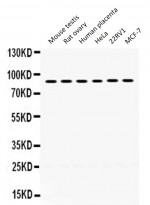
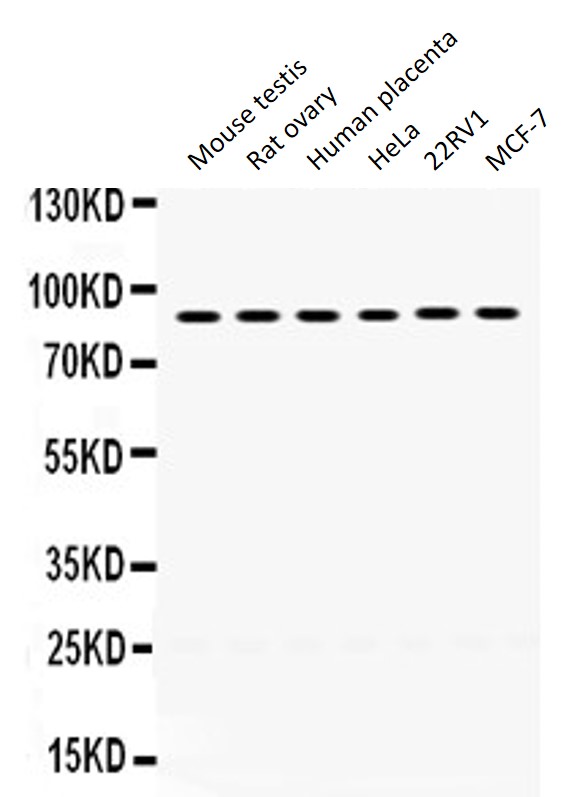
ARG58833 anti-LOXL2 antibody WB image
Western blot: 50 µg of Mouse testis, 50 µg of Rat ovary, 50 µg of Human placenta, 40 µg of HeLa, 40 µg of 22RV1 and 40 µg of MCF-7 lysates stained with ARG58833 anti-LOXL2 antibody at 0.5 µg/ml dilution.