ARG44863
anti-LZTFL1 antibody
anti-LZTFL1 antibody for IHC-Formalin-fixed paraffin-embedded sections and Human
Overview
| Product Description | Mouse Monoclonal antibody recognizes LZTFL1 |
|---|---|
| Tested Reactivity | Hu |
| Tested Application | IHC-P |
| Host | Mouse |
| Clonality | Monoclonal |
| Isotype | IgG1 |
| Target Name | LZTFL1 |
| Antigen Species | Human |
| Epitope | NKEILRLQEE NEKLKSRLKT IEIQATNALD EKSKLEKALQ DLQLDQGNQK DFIKAQDLSN LENTVAALKS EFQKTLNDKT ENQKSLEENL ATAKHDLLRV |
| Conjugation | Un-conjugated |
| Alternate Names | LZTFL1; Leucine Zipper Transcription Factor Like 1; BBS17; Leucine Zipper Transcription Factor-Like Protein 1; Leucine Zipper Transcription Factor-Like 1 |
Application Instructions
| Application Suggestion |
|
||||
|---|---|---|---|---|---|
| Application Note | * The dilutions indicate recommended starting dilutions and the optimal dilutions or concentrations should be determined by the scientist. |
Properties
| Form | Liquid |
|---|---|
| Purification | Protein A purification |
| Buffer | PBS with 0.09% sodium azide |
| Preservative | 0.09% sodium azide |
| Storage Instruction | For continuous use, store undiluted antibody at 2-8°C for up to a week. For long-term storage, aliquot and store at -20°C or below. Storage in frost free freezers is not recommended. Avoid repeated freeze/thaw cycles. Suggest spin the vial prior to opening. The antibody solution should be gently mixed before use. |
| Note | For laboratory research only, not for drug, diagnostic or other use. |
Bioinformation
| Database Links |
Swiss-port # Q9NQ48 Human Leucine zipper transcription factor-like protein 1 |
|---|---|
| Gene Symbol | LZTFL1 |
| Gene Full Name | Leucine Zipper Transcription Factor Like 1 |
| Background | This gene encodes a ubiquitously expressed protein that localizes to the cytoplasm. This protein interacts with Bardet-Biedl Syndrome (BBS) proteins and, through its interaction with BBS protein complexes, regulates protein trafficking to the ciliary membrane. Nonsense mutations in this gene cause a form of Bardet-Biedl Syndrome; a ciliopathy characterized in part by polydactyly, obesity, cognitive impairment, hypogonadism, and kidney failure. This gene may also function as a tumor suppressor; possibly by interacting with E-cadherin and the actin cytoskeleton and thereby regulating the transition of epithelial cells to mesenchymal cells. [provided by RefSeq, Aug 2020] |
| Function | Regulates ciliary localization of the BBSome complex. Together with the BBSome complex, controls SMO ciliary trafficking and contributes to the sonic hedgehog (SHH) pathway regulation. May play a role in neurite outgrowth. May have tumor suppressor function. [Uniprot] |
| Cellular Localization | Cytoplasm. [Uniprot] |
Images (1) Click the Picture to Zoom In
-
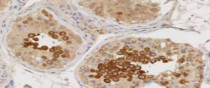
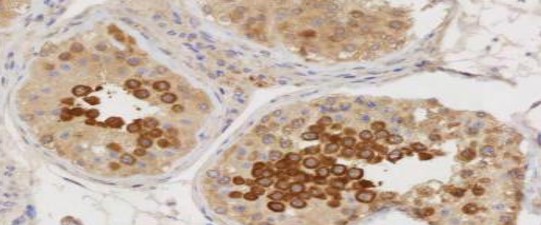
ARG44863 anti-LZTFL1 antibody IHC-P image
Immunohistochemistry: Human testis stained with ARG44863 anti-LZTFL1 antibody at 5 µg/mL dilution.