Click to copy cat No.
ARG56340
Click to copy product name
anti-NTHL1 antibody
anti-NTHL1 antibody for Western blot and Human
Overview
| Product Description | Rabbit Polyclonal antibody recognizes NTHL1 |
|---|---|
| Tested Reactivity | Hu |
| Tested Application | WB |
| Host | Rabbit |
| Clonality | Polyclonal |
| Isotype | IgG |
| Target Name | NTHL1 |
| Antigen Species | Human |
| Immunogen | Recombinant protein of Human NTHL1 |
| Conjugation | Un-conjugated |
| Alternate Names | NTH1; EC 4.2.99.18; Endonuclease III-like protein 1; hNTH1; Bifunctional DNA N-glycoslyase/DNA-; FAP3; OCTS3; apurinic or apyrimidinic site; DNA glycoslyase/AP lyase; EC 3.2.2.- |
Application Instructions
| Application Suggestion |
|
||||
|---|---|---|---|---|---|
| Application Note | * The dilutions indicate recommended starting dilutions and the optimal dilutions or concentrations should be determined by the scientist. | ||||
| Positive Control | MCF7 |
Properties
| Form | Liquid |
|---|---|
| Purification | Affinity purification with immunogen. |
| Buffer | PBS (pH 7.3), 0.02% Sodium azide and 50% Glycerol. |
| Preservative | 0.02% sodium azide |
| Stabilizer | 50% Glycerol |
| Storage Instruction | For continuous use, store undiluted antibody at 2-8°C for up to a week. For long-term storage, aliquot and store at -20°C. Storage in frost free freezers is not recommended. Avoid repeated freeze/thaw cycles. Suggest spin the vial prior to opening. The antibody solution should be gently mixed before use. |
| Note | For laboratory research only, not for drug, diagnostic or other use. |
Bioinformation
| Database Links | |
|---|---|
| Gene Symbol | NTHL1 |
| Gene Full Name | nth-like DNA glycosylase 1 |
| Background | The protein encoded by this gene is a DNA N-glycosylase of the endonuclease III family. Like a similar protein in E. coli, the encoded protein has DNA glycosylase activity on DNA substrates containing oxidized pyrimidine residues and has apurinic/apyrimidinic lyase activity. [provided by RefSeq, Oct 2008] |
| Function | Bifunctional DNA N-glycosylase with associated apurinic/apyrimidinic (AP) lyase function that catalyzes the first step in base excision repair (BER), the primary repair pathway for the repair of oxidative DNA damage. The DNA N-glycosylase activity releases the damaged DNA base from DNA by cleaving the N-glycosidic bond, leaving an AP site. The AP-lyase activity cleaves the phosphodiester bond 3' to the AP site by a beta-elimination. Primarily recognizes and repairs oxidative base damage of pyrimidines. Has also 8-oxo-7,8-dihydroguanine (8-oxoG) DNA glycosylase activity. Acts preferentially on DNA damage opposite guanine residues in DNA. Is able to process lesions in nucleosomes without requiring or inducing nucleosome disruption. [UniProt] |
| Calculated MW | 34 kDa |
Images (1) Click the Picture to Zoom In
-
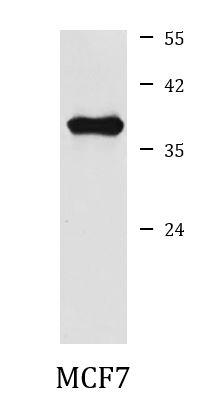
ARG56340 anti-NTHL1 antibody WB image
Western blot: MCF7 cell lysate stained with ARG56340 anti-NTHL1 antibody.