Click to copy cat No.
ARG40505
Click to copy product name
anti-OLR1 / LOX1 antibody
anti-OLR1 / LOX1 antibody for Western blot and Human,Rat
Overview
| Product Description | Rabbit Polyclonal antibody recognizes OLR1 / LOX1 |
|---|---|
| Tested Reactivity | Hu, Rat |
| Tested Application | WB |
| Host | Rabbit |
| Clonality | Polyclonal |
| Isotype | IgG |
| Target Name | OLR1 / LOX1 |
| Antigen Species | Human |
| Immunogen | Synthetic peptide corresponding to aa. 114-127 of Human OLR1 / LOX1. (NEKSKEQMELHHQN) |
| Conjugation | Un-conjugated |
| Alternate Names | Lectin-like oxidized LDL receptor 1; Lectin-type oxidized LDL receptor 1; LOX-1; CLEC8A; SLOX1; LOXIN; hLOX-1; Oxidized low-density lipoprotein receptor 1; Lectin-like oxLDL receptor 1; C-type lectin domain family 8 member A; Ox-LDL receptor 1; LOX1; SCARE1 |
Application Instructions
| Application Suggestion |
|
||||
|---|---|---|---|---|---|
| Application Note | * The dilutions indicate recommended starting dilutions and the optimal dilutions or concentrations should be determined by the scientist. |
Properties
| Form | Liquid |
|---|---|
| Purification | Affinity purification with immunogen. |
| Buffer | 0.2% Na2HPO4, 0.9% NaCl, 0.05% Thimerosal, 0.05% Sodium azide and 5% BSA. |
| Preservative | 0.05% Thimerosal and 0.05% Sodium azide |
| Stabilizer | 5% BSA |
| Concentration | 0.5 mg/ml |
| Storage Instruction | For continuous use, store undiluted antibody at 2-8°C for up to a week. For long-term storage, aliquot and store at -20°C or below. Storage in frost free freezers is not recommended. Avoid repeated freeze/thaw cycles. Suggest spin the vial prior to opening. The antibody solution should be gently mixed before use. |
| Note | For laboratory research only, not for drug, diagnostic or other use. |
Bioinformation
| Database Links |
Swiss-port # O70156 Rat Oxidized low-density lipoprotein receptor 1 Swiss-port # P78380 Human Oxidized low-density lipoprotein receptor 1 |
|---|---|
| Gene Symbol | OLR1 |
| Gene Full Name | oxidized low density lipoprotein (lectin-like) receptor 1 |
| Background | This gene encodes a low density lipoprotein receptor that belongs to the C-type lectin superfamily. This gene is regulated through the cyclic AMP signaling pathway. The encoded protein binds, internalizes and degrades oxidized low-density lipoprotein. This protein may be involved in the regulation of Fas-induced apoptosis. This protein may play a role as a scavenger receptor. Mutations of this gene have been associated with atherosclerosis, risk of myocardial infarction, and may modify the risk of Alzheimer's disease. Alternate splicing results in multiple transcript variants.[provided by RefSeq, Feb 2010] |
| Function | Receptor that mediates the recognition, internalization and degradation of oxidatively modified low density lipoprotein (oxLDL) by vascular endothelial cells. OxLDL is a marker of atherosclerosis that induces vascular endothelial cell activation and dysfunction, resulting in pro-inflammatory responses, pro-oxidative conditions and apoptosis. Its association with oxLDL induces the activation of NF-kappa-B through an increased production of intracellular reactive oxygen and a variety of pro-atherogenic cellular responses including a reduction of nitric oxide (NO) release, monocyte adhesion and apoptosis. In addition to binding oxLDL, it acts as a receptor for the HSP70 protein involved in antigen cross-presentation to naive T-cells in dendritic cells, thereby participating in cell-mediated antigen cross-presentation. Also involved in inflammatory process, by acting as a leukocyte-adhesion molecule at the vascular interface in endotoxin-induced inflammation. Also acts as a receptor for advanced glycation end (AGE) products, activated platelets, monocytes, apoptotic cells and both Gram-negative and Gram-positive bacteria. [UniProt] |
| Cellular Localization | Cell membrane; Lipid-anchor. Cell membrane; Single-pass type II membrane protein. Membrane raft. Secreted. Note=A secreted form also exists. Localization to membrane rafts requires palmitoylation. [UniProt] |
| Calculated MW | 31 kDa |
| PTM | The intrachain disulfide-bonds prevent N-glycosylation at some sites. N-glycosylated. [UniProt] |
Images (1) Click the Picture to Zoom In
-
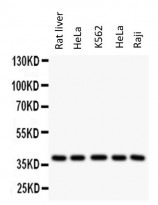
ARG40505 anti-OLR1 / LOX1 antibody WB image
Western blot: 50 µg of Rat liver, 40 µg of HeLa, 40 µg of K562, 40 µg of HeLa and 40 µg of Raji whole cell lysates stained with ARG40505 anti-OLR1 / LOX1 antibody at 0.5 µg/ml dilution.