ARG40156
anti-OPRL1 / Nociceptin Receptor antibody
anti-OPRL1 / Nociceptin Receptor antibody for Western blot and Human
Overview
| Product Description | Rabbit Polyclonal antibody recognizes OPRL1 / Nociceptin Receptor |
|---|---|
| Tested Reactivity | Hu |
| Tested Application | WB |
| Host | Rabbit |
| Clonality | Polyclonal |
| Isotype | IgG |
| Target Name | OPRL1 / Nociceptin Receptor |
| Antigen Species | Human |
| Immunogen | Synthetic peptide around the C-terminal region of Human OPRL1. (within the following region: ALGYVNSCLNPILYAFLDENFKACFRKFCCASALRRDVQVSDRVRSIAKD) |
| Conjugation | Un-conjugated |
| Alternate Names | Nociceptin receptor; ORL1; Orphanin FQ receptor; NOCIR; Kappa-type 3 opioid receptor; OOR; KOR-3 |
Application Instructions
| Application Suggestion |
|
||||
|---|---|---|---|---|---|
| Application Note | * The dilutions indicate recommended starting dilutions and the optimal dilutions or concentrations should be determined by the scientist. |
Properties
| Form | Liquid |
|---|---|
| Purification | Affinity purified. |
| Buffer | PBS, 0.09% (w/v) Sodium azide and 2% Sucrose. |
| Preservative | 0.09% (w/v) Sodium azide |
| Stabilizer | 2% Sucrose |
| Concentration | Batch dependent: 0.5 - 1 mg/ml |
| Storage Instruction | For continuous use, store undiluted antibody at 2-8°C for up to a week. For long-term storage, aliquot and store at -20°C or below. Storage in frost free freezers is not recommended. Avoid repeated freeze/thaw cycles. Suggest spin the vial prior to opening. The antibody solution should be gently mixed before use. |
| Note | For laboratory research only, not for drug, diagnostic or other use. |
Bioinformation
| Database Links | |
|---|---|
| Gene Symbol | OPRL1 |
| Gene Full Name | opiate receptor-like 1 |
| Background | The protein encoded by this gene is a G protein-coupled receptor whose expression can be induced by phytohemagglutinin. The encoded integral membrane protein is a receptor for the 17 aa neuropeptide nociceptin/orphanin FQ. This gene may be involved in the regulation of numerous brain activities, particularly instinctive and emotional behaviors. A promoter for this gene also functions as a promoter for another gene, regulator of G-protein signalling 19 (RGS19), located on the opposite strand. Three transcript variants encoding the same protein have been found for this gene. [provided by RefSeq, Jan 2011] |
| Function | G-protein coupled opioid receptor that functions as receptor for the endogenous neuropeptide nociceptin. Ligand binding causes a conformation change that triggers signaling via guanine nucleotide-binding proteins (G proteins) and modulates the activity of down-stream effectors. Signaling via G proteins mediates inhibition of adenylate cyclase activity and calcium channel activity. Arrestins modulate signaling via G proteins and mediate the activation of alternative signaling pathways that lead to the activation of MAP kinases. Plays a role in modulating nociception and the perception of pain. Plays a role in the regulation of locomotor activity by the neuropeptide nociceptin. [UniProt] |
| Cellular Localization | Cell membrane; Multi-pass membrane protein. Cytoplasmic vesicle. Note=Ligand binding leads to receptor internalization into cytoplasmic vesicles, decreasing the amount of available receptor at the cell surface. Internalization requires phosphorylation at Ser-363. Can recycle to the cell membrane. [UniProt] |
| Calculated MW | 41 kDa |
| PTM | Phosphorylation at Ser-363 requires GRK3. [UniProt] |
Images (1) Click the Picture to Zoom In
-
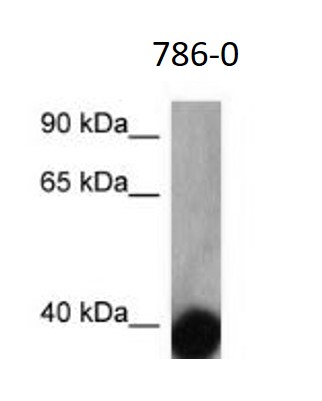
ARG40156 anti-OPRL1 / Nociceptin Receptor antibody WB image
Western blot: Human 786-0 whole cell lysate stained with ARG40156 anti-OPRL1 / Nociceptin Receptor antibody at 1 µg/ml dilution.