ARG43366
anti-P2RX7 / P2X7 antibody
anti-P2RX7 / P2X7 antibody for Western blot and Mouse
Overview
| Product Description | Rabbit Polyclonal antibody recognizes P2RX7 / P2X7 |
|---|---|
| Tested Reactivity | Ms |
| Tested Application | WB |
| Host | Rabbit |
| Clonality | Polyclonal |
| Isotype | IgG |
| Target Name | P2RX7 / P2X7 |
| Antigen Species | Mouse |
| Immunogen | Recombinant protein corresponding to N380-E585 of Mouse P2RX7 / P2X7. |
| Conjugation | Un-conjugated |
| Alternate Names | ATP receptor; P2X7; P2X purinoceptor 7; P2Z receptor; Purinergic receptor |
Application Instructions
| Application Suggestion |
|
||||
|---|---|---|---|---|---|
| Application Note | * The dilutions indicate recommended starting dilutions and the optimal dilutions or concentrations should be determined by the scientist. | ||||
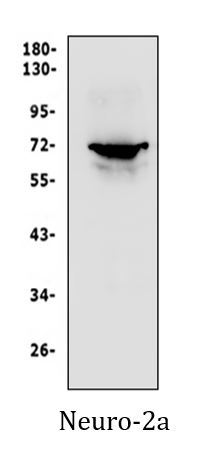
| Positive Control | Neuro-2a | ||||
| Observed Size | ~ 70 kDa |
Properties
| Form | Liquid |
|---|---|
| Purification | Affinity purification with immunogen. |
| Buffer | 0.2% Na2HPO4, 0.9% NaCl, 0.01% Sodium azide and 4% Trehalose. |
| Preservative | 0.01% Sodium azide |
| Stabilizer | 4% Trehalose |
| Concentration | 0.5 mg/ml |
| Storage Instruction | For continuous use, store undiluted antibody at 2-8°C for up to a week. For long-term storage, aliquot and store at -20°C or below. Storage in frost free freezers is not recommended. Avoid repeated freeze/thaw cycles. Suggest spin the vial prior to opening. The antibody solution should be gently mixed before use. |
| Note | For laboratory research only, not for drug, diagnostic or other use. |
Bioinformation
| Database Links | |
|---|---|
| Gene Symbol | P2RX7 |
| Gene Full Name | purinergic receptor P2X, ligand gated ion channel, 7 |
| Background | The product of this gene belongs to the family of purinoceptors for ATP. This receptor functions as a ligand-gated ion channel and is responsible for ATP-dependent lysis of macrophages through the formation of membrane pores permeable to large molecules. Activation of this nuclear receptor by ATP in the cytoplasm may be a mechanism by which cellular activity can be coupled to changes in gene expression. Multiple alternatively spliced variants have been identified, most of which fit nonsense-mediated decay (NMD) criteria. [provided by RefSeq, Jul 2010] |
| Function | Receptor for ATP that acts as a ligand-gated ion channel. Responsible for ATP-dependent lysis of macrophages through the formation of membrane pores permeable to large molecules. Could function in both fast synaptic transmission and the ATP-mediated lysis of antigen-presenting cells. In the absence of its natural ligand, ATP, functions as a scavenger receptor in the recognition and engulfment of apoptotic cells (PubMed:21821797, PubMed:23303206). [UniProt] |
| Cellular Localization | Cell membrane; Multi-pass membrane protein. [UniProt] |
| Calculated MW | 68 kDa |
| PTM | Phosphorylation results in its inactivation. ADP-ribosylation at Arg-125 is necessary and sufficient to activate P2RX7 and gate the channel. Palmitoylation of several cysteines in the C-terminal cytoplasmic tail is required for efficient localization to cell surface. [UniProt] |
Images (1) Click the Picture to Zoom In
-
ARG43366 anti-P2RX7 / P2X7 antibody WB image
Western blot: 30 µg of sample under reducing conditions. Neuro-2a whole cell lysate stained with ARG43366 anti-P2RX7 / P2X7 antibody at 0.5 µg/ml dilution, overnight at 4°C.