ARG43819
anti-SAPK / JNK antibody
anti-SAPK / JNK antibody for Immunoprecipitation,Western blot and Human,Mouse,Rat,Hamster
Overview
| Product Description | Rabbit Polyclonal antibody recognizes SAPK / JNK |
|---|---|
| Tested Reactivity | Hu, Ms, Rat, Hm |
| Tested Application | IP, WB |
| Specificity | Human,Mouse,Rat,Hamster |
| Host | Rabbit |
| Clonality | Polyclonal |
| Isotype | IgG |
| Target Name | MAPK8 |
| Antigen Species | Human |
| Immunogen | Synthetic peptide of human JNK. |
| Conjugation | Un-conjugated |
| Protein Full Name | Mitogen-activated protein kinase 8 |
| Alternate Names | MAPK8; Mitogen-Activated Protein Kinase 8; SAPK1; JNK1; PRKM8; JNK; Stress-Activated Protein Kinase 1c; C-Jun N-Terminal Kinase 1; JUN N-Terminal Kinase; MAP Kinase 8; EC 2.7.11.24; JNK-46; SAPK1c; Stress-Activated Protein Kinase JNK1; Stress-Activated Protein Kinase 1; JNK21B1/2; EC 2.7.11; JNK1A2; SAPK1C; MAPK 8 |
Application Instructions
| Application Suggestion |
|
||||||
|---|---|---|---|---|---|---|---|
| Application Note | * The dilutions indicate recommended starting dilutions and the optimal dilutions or concentrations should be determined by the scientist. | ||||||
| Observed Size | 46-54 kDa |
Properties
| Form | Liquid |
|---|---|
| Purification | Affinity Purified |
| Buffer | Tris-Glycine, 0.15M NaCl, 40% Glycerol, 0.01% Sodium azide and 0.05% BSA |
| Preservative | 0.01% Sodium azide |
| Stabilizer | 40% Glycerol and 0.05% BSA |
| Storage Instruction | For continuous use, store undiluted antibody at 2-8°C for up to a week. For long-term storage, aliquot and store at -20°C or below. Storage in frost free freezers is not recommended. Avoid repeated freeze/thaw cycles. Suggest spin the vial prior to opening. The antibody solution should be gently mixed before use. |
| Note | For laboratory research only, not for drug, diagnostic or other use. |
Bioinformation
| Database Links | |
|---|---|
| Gene Symbol | MAPK8 |
| Gene Full Name | Mitogen-Activated Protein Kinase 8 |
| Background | The protein encoded by this gene is a member of the MAP kinase family. MAP kinases act as an integration point for multiple biochemical signals, and are involved in a wide variety of cellular processes such as proliferation, differentiation, transcription regulation and development. This kinase is activated by various cell stimuli, and targets specific transcription factors, and thus mediates immediate-early gene expression in response to cell stimuli. The activation of this kinase by tumor-necrosis factor alpha (TNF-alpha) is found to be required for TNF-alpha induced apoptosis. This kinase is also involved in UV radiation induced apoptosis, which is thought to be related to cytochrom c-mediated cell death pathway. Studies of the mouse counterpart of this gene suggested that this kinase play a key role in T cell proliferation, apoptosis and differentiation. Several alternatively spliced transcript variants encoding distinct isoforms have been reported. [provided by RefSeq, Apr 2016] |
| Function | JNK1 isoforms display different binding patterns: beta-1 preferentially binds to c-Jun, whereas alpha-1, alpha-2, and beta-2 have a similar low level of binding to both c-Jun or ATF2. However, there is no correlation between binding and phosphorylation, which is achieved at about the same efficiency by all isoforms. [UniProt] |
| Cellular Localization | Cytoplasm, Nucleus, Synapse. [UniProt] |
| Calculated MW | 48 kDa |
| PTM | Phosphoprotein, S-nitrosylation. [UniProt] |
Images (2) Click the Picture to Zoom In
-
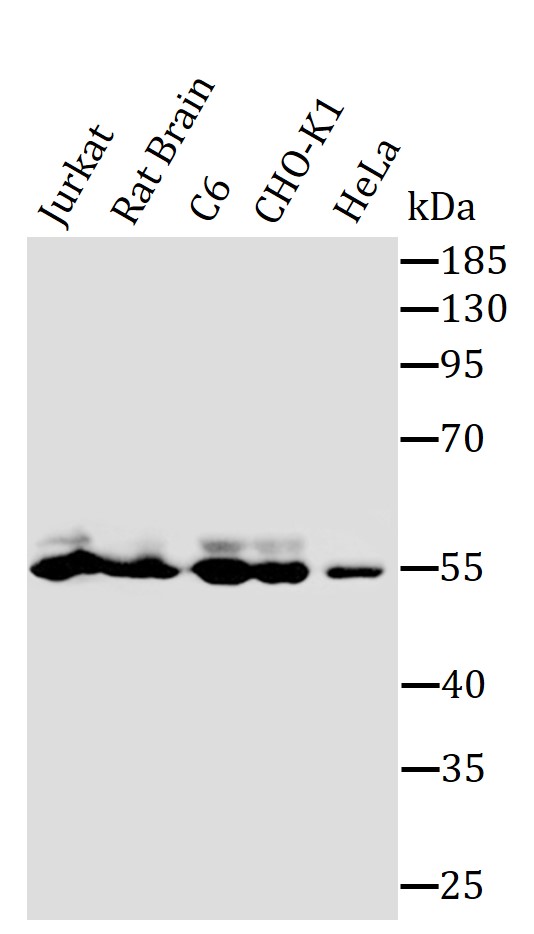
ARG43819 anti-SAPK / JNK antibody WB image
Western blot: Jurkat, Rat Brain, C6, CHO-K1 and HeLa cells stained with ARG43819 anti-SAPK / JNK antibody at 1:500 dilution.
-
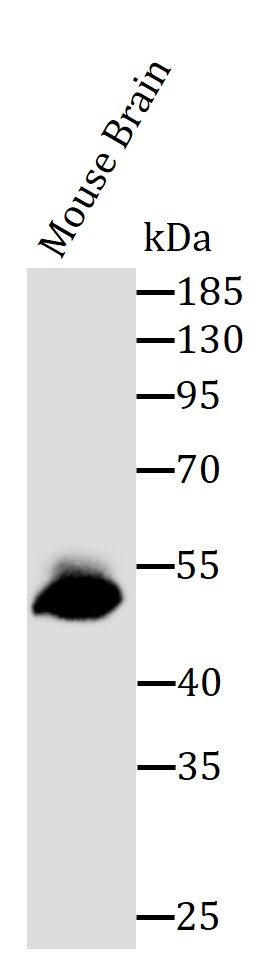
ARG43819 anti-SAPK / JNK antibody WB image
Western blot: Mouse Brain stained with ARG43819 anti-SAPK / JNK antibody at 1:500 dilution.