ARG65143
anti-TGFBI antibody
anti-TGFBI antibody for ICC/IF,IHC-Formalin-fixed paraffin-embedded sections,Western blot and Human
Developmental Biology antibody; Neuroscience antibody; Signaling Transduction antibody
Overview
| Product Description | Goat Polyclonal antibody recognizes TGFBI |
|---|---|
| Tested Reactivity | Hu |
| Predict Reactivity | Ms, Rat, Dog |
| Tested Application | ICC/IF, IHC-P, WB |
| Host | Goat |
| Clonality | Polyclonal |
| Isotype | IgG |
| Target Name | TGFBI |
| Antigen Species | Human |
| Immunogen | C-QLYTDRTEKLRPE |
| Conjugation | Un-conjugated |
| Alternate Names | CDGG1; LCD1; RGD-CAP; CSD2; CSD; Beta ig-h3; CSD1; Transforming growth factor-beta-induced protein ig-h3; RGD-containing collagen-associated protein; BIGH3; CDG2; CSD3; Kerato-epithelin; CDB1; EBMD |
Application Instructions
| Application Suggestion |
|
||||||||
|---|---|---|---|---|---|---|---|---|---|
| Application Note | IHC-P: Antigen Retrieval: Steam tissue section in Citrate buffer (pH 6.0). WB: Recommend incubate at RT for 1h. * The dilutions indicate recommended starting dilutions and the optimal dilutions or concentrations should be determined by the scientist. |
Properties
| Form | Liquid |
|---|---|
| Purification | Purified from goat serum by antigen affinity chromatography. |
| Buffer | Tris saline (pH 7.3), 0.02% Sodium azide and 0.5% BSA. |
| Preservative | 0.02% Sodium azide |
| Stabilizer | 0.5% BSA |
| Concentration | 0.5 mg/ml |
| Storage Instruction | For continuous use, store undiluted antibody at 2-8°C for up to a week. For long-term storage, aliquot and store at -20°C or below. Storage in frost free freezers is not recommended. Avoid repeated freeze/thaw cycles. Suggest spin the vial prior to opening. The antibody solution should be gently mixed before use. |
| Note | For laboratory research only, not for drug, diagnostic or other use. |
Bioinformation
| Database Links |
Swiss-port # Q15582 Human Transforming growth factor-beta-induced protein ig-h3 |
|---|---|
| Background | This gene encodes an RGD-containing protein that binds to type I, II and IV collagens. The RGD motif is found in many extracellular matrix proteins modulating cell adhesion and serves as a ligand recognition sequence for several integrins. This protein plays a role in cell-collagen interactions and may be involved in endochondrial bone formation in cartilage. The protein is induced by transforming growth factor-beta and acts to inhibit cell adhesion. Mutations in this gene are associated with multiple types of corneal dystrophy. [provided by RefSeq, Jul 2008] |
| Research Area | Developmental Biology antibody; Neuroscience antibody; Signaling Transduction antibody |
| Calculated MW | 75 kDa |
| PTM | Gamma-carboxylation is controversial. Gamma-carboxyglutamated; gamma-carboxyglutamate residues are formed by vitamin K dependent carboxylation; these residues may be required for binding to calcium (PubMed:18450759). According to a more recent report, does not contain vitamin K-dependent gamma-carboxyglutamate residues (PubMed:26273833). The EMI domain contains 2 expected intradomain disulfide bridges (Cys-49-Cys85 and Cys-84-Cys-97) and one unusual interdomain disulfide bridge to the second FAS1 domain (Cys-74-Cys-339). This arrangement violates the predicted disulfide bridge pattern of an EMI domain. |
Images (3) Click the Picture to Zoom In
-
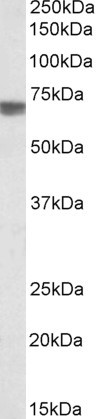
ARG65143 anti-TGFBI antibody WB image
Western Blot: Human Kidney lysate (35 µg protein in RIPA buffer) stained with ARG65143 anti-TGFBI antibody at 0.3 µg/ml dilution.
-
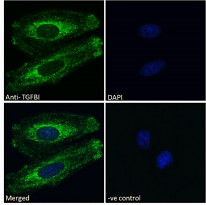
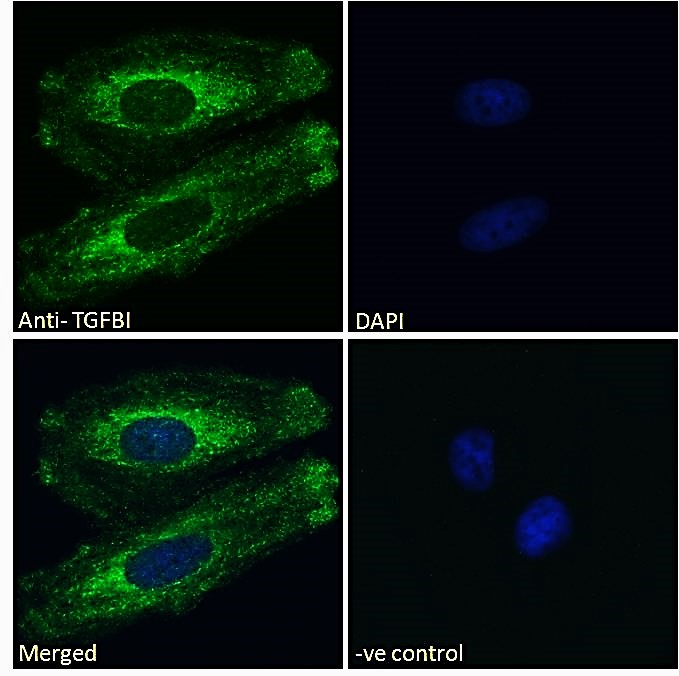
ARG65143 anti-TGFBI antibody ICC/IF image
Immunofluorescence: Paraformaldehyde fixed HeLa cells permeabilized with 0.15% Triton. Cells were stained with ARG65143 anti-TGFBI antibody (green) at 10 µg/ml dilution for 1 hour. DAPI (blue) for nuclear staining. Negative control: Unimmunized goat IgG (green) at 10 µg/ml dilution.
-
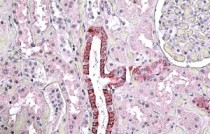
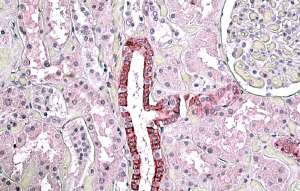
ARG65143 anti-TGFBI antibody IHC-P image
Immunohistochemistry: paraffin embedded Human Kidney. (Steamed antigen retrieval with citrate buffer pH 6) stained with ARG65143 anti-TGFBI antibody at 3.8 µg/ml dilution followed by AP-staining.