ARG59145
anti-TLR5 antibody
anti-TLR5 antibody for IHC-Formalin-fixed paraffin-embedded sections and Rat
Overview
| Product Description | Rabbit Polyclonal antibody recognizes TLR5 |
|---|---|
| Tested Reactivity | Rat |
| Predict Reactivity | Hu, Ms |
| Tested Application | IHC-P |
| Host | Rabbit |
| Clonality | Polyclonal |
| Isotype | IgG |
| Target Name | TLR5 |
| Antigen Species | Human |
| Immunogen | Synthetic peptide corresponding to 16 aa of Human TLR5. (within aa. 450 - 500) |
| Conjugation | Un-conjugated |
| Alternate Names | Toll/interleukin-1 receptor-like protein 3; MELIOS; TIL3; SLEB1; Toll-like receptor 5; SLE1 |
Application Instructions
| Application Suggestion |
|
||||
|---|---|---|---|---|---|
| Application Note | * The dilutions indicate recommended starting dilutions and the optimal dilutions or concentrations should be determined by the scientist. | ||||
| Positive Control | Rat brain |
Properties
| Form | Liquid |
|---|---|
| Purification | Affinity purification with immunogen. |
| Buffer | PBS and 0.02% Sodium azide. |
| Preservative | 0.02% Sodium azide |
| Concentration | 1 mg/ml |
| Storage Instruction | For continuous use, store undiluted antibody at 2-8°C for up to a week. For long-term storage, aliquot and store at -20°C or below. Storage in frost free freezers is not recommended. Avoid repeated freeze/thaw cycles. Suggest spin the vial prior to opening. The antibody solution should be gently mixed before use. |
| Note | For laboratory research only, not for drug, diagnostic or other use. |
Bioinformation
| Gene Symbol | TLR5 |
|---|---|
| Gene Full Name | toll-like receptor 5 |
| Background | This gene encodes a member of the toll-like receptor (TLR) family, which plays a fundamental role in pathogen recognition and activation of innate immune responses. These receptors recognize distinct pathogen-associated molecular patterns that are expressed on infectious agents. The protein encoded by this gene recognizes bacterial flagellin, the principal component of bacterial flagella and a virulence factor. The activation of this receptor mobilizes the nuclear factor NF-kappaB, which in turn activates a host of inflammatory-related target genes. Mutations in this gene have been associated with both resistance and susceptibility to systemic lupus erythematosus, and susceptibility to Legionnaire disease.[provided by RefSeq, Dec 2009] |
| Function | Participates in the innate immune response to microbial agents. Mediates detection of bacterial flagellins. Acts via MYD88 and TRAF6, leading to NF-kappa-B activation, cytokine secretion and the inflammatory response. [UniProt] |
| Cellular Localization | Membrane; Single-pass type I membrane protein. [UniProt] |
| Calculated MW | 98 kDa |
| PTM | Phosphorylated at Ser-805 by PKD/PRKD1; phosphorylation induces the production of inflammatory cytokines. Phosphorylated at Tyr-798 upon flagellin binding; required for signaling. [UniProt] |
Images (1) Click the Picture to Zoom In
-
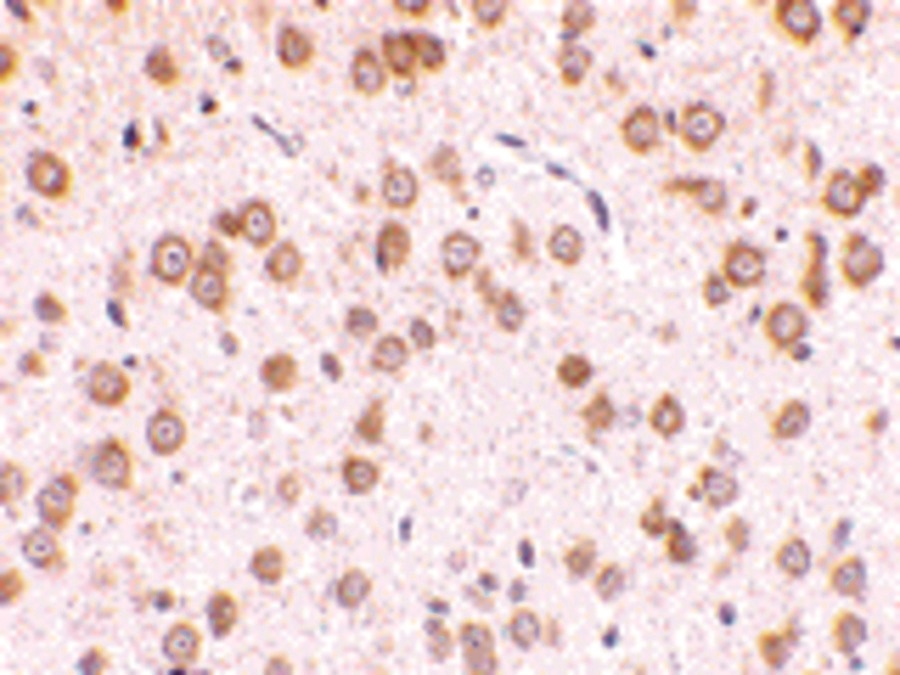
ARG59145 anti-TLR5 antibody IHC-P image
Immunohistochemistry: Paraffin-embedded Rat brain stained with ARG59145 anti-TLR5 antibody at 10 µg/ml dilution.