Click to copy cat No.
ARG64974
Click to copy product name
anti-TPP1 antibody
anti-TPP1 antibody for Western blot and Human
Cell Biology and Cellular Response antibody; Neuroscience antibody
Overview
| Product Description | Goat Polyclonal antibody recognizes TPP1 |
|---|---|
| Tested Reactivity | Hu |
| Predict Reactivity | Cow, Dog |
| Tested Application | WB |
| Host | Goat |
| Clonality | Polyclonal |
| Isotype | IgG |
| Target Name | TPP1 |
| Antigen Species | Human |
| Immunogen | C-TPSVIRKRYNLTSQD |
| Conjugation | Un-conjugated |
| Alternate Names | EC 3.4.14.9; TPP-1; Tripeptidyl-peptidase I; GIG1; Lysosomal pepstatin-insensitive protease; SCAR7; Tripeptidyl aminopeptidase; Tripeptidyl-peptidase 1; CLN2; LPIC; Cell growth-inhibiting gene 1 protein; TPP-I |
Application Instructions
| Application Suggestion |
|
||||
|---|---|---|---|---|---|
| Application Note | WB: Recommend incubate at RT for 1h. * The dilutions indicate recommended starting dilutions and the optimal dilutions or concentrations should be determined by the scientist. |
Properties
| Form | Liquid |
|---|---|
| Purification | Purified from goat serum by antigen affinity chromatography. |
| Buffer | Tris saline (pH 7.3), 0.02% Sodium azide and 0.5% BSA. |
| Preservative | 0.02% Sodium azide |
| Stabilizer | 0.5% BSA |
| Concentration | 0.5 mg/ml |
| Storage Instruction | For continuous use, store undiluted antibody at 2-8°C for up to a week. For long-term storage, aliquot and store at -20°C or below. Storage in frost free freezers is not recommended. Avoid repeated freeze/thaw cycles. Suggest spin the vial prior to opening. The antibody solution should be gently mixed before use. |
| Note | For laboratory research only, not for drug, diagnostic or other use. |
Bioinformation
| Database Links | |
|---|---|
| Background | This gene encodes a member of the sedolisin family of serine proteases. The protease functions in the lysosome to cleave N-terminal tripeptides from substrates, and has weaker endopeptidase activity. It is synthesized as a catalytically-inactive enzyme which is activated and auto-proteolyzed upon acidification. Mutations in this gene result in late-infantile neuronal ceroid lipofuscinosis, which is associated with the failure to degrade specific neuropeptides and a subunit of ATP synthase in the lysosome. [provided by RefSeq, Jul 2008] |
| Research Area | Cell Biology and Cellular Response antibody; Neuroscience antibody |
| Calculated MW | 61 kDa |
| PTM | Activated by autocatalytic proteolytical processing upon acidification. N-glycosylation is required for processing and activity. |
Images (1) Click the Picture to Zoom In
-
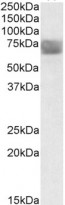
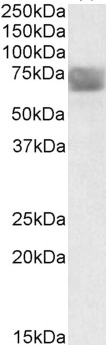
ARG64974 anti-TPP1 antibody WB image
Western blot: 35 µg of Human Placenta lysate stained with ARG64974 anti-TPP1 antibody at 0.3 µg/ml dilution.