Click to copy cat No.
ARG57019
Click to copy product name
anti-Thymine DNA glycosylase antibody [2F7]
anti-Thymine DNA glycosylase antibody [2F7] for Western blot and Human
Overview
| Product Description | Mouse Monoclonal antibody [2F7] recognizes Thymine DNA glycosylase |
|---|---|
| Tested Reactivity | Hu |
| Tested Application | WB |
| Host | Mouse |
| Clonality | Monoclonal |
| Clone | 2F7 |
| Isotype | IgG1, kappa |
| Target Name | Thymine DNA glycosylase |
| Antigen Species | Human |
| Immunogen | Recombinant fragment around aa. 1-410 of Human Thymine DNA glycosylase. |
| Conjugation | Un-conjugated |
| Alternate Names | G/T mismatch-specific thymine DNA glycosylase; hTDG; Thymine-DNA glycosylase; EC 3.2.2.29 |
Application Instructions
| Application Suggestion |
|
||||
|---|---|---|---|---|---|
| Application Note | * The dilutions indicate recommended starting dilutions and the optimal dilutions or concentrations should be determined by the scientist. |
Properties
| Form | Liquid |
|---|---|
| Purification | Purification with Protein A. |
| Buffer | PBS (pH 7.4), 0.02% Sodium azide and 10% Glycerol. |
| Preservative | 0.02% Sodium azide |
| Stabilizer | 10% Glycerol |
| Concentration | 1 mg/ml |
| Storage Instruction | For continuous use, store undiluted antibody at 2-8°C for up to a week. For long-term storage, aliquot and store at -20°C. Storage in frost free freezers is not recommended. Avoid repeated freeze/thaw cycles. Suggest spin the vial prior to opening. The antibody solution should be gently mixed before use. |
| Note | For laboratory research only, not for drug, diagnostic or other use. |
Bioinformation
| Database Links |
Swiss-port # Q13569 Human G/T mismatch-specific thymine DNA glycosylase |
|---|---|
| Gene Symbol | TDG |
| Gene Full Name | thymine DNA glycosylase |
| Background | The protein encoded by this gene belongs to the TDG/mug DNA glycosylase family. Thymine-DNA glycosylase (TDG) removes thymine moieties from G/T mismatches by hydrolyzing the carbon-nitrogen bond between the sugar-phosphate backbone of DNA and the mispaired thymine. With lower activity, this enzyme also removes thymine from C/T and T/T mispairings. TDG can also remove uracil and 5-bromouracil from mispairings with guanine. This enzyme plays a central role in cellular defense against genetic mutation caused by the spontaneous deamination of 5-methylcytosine and cytosine. This gene may have a pseudogene in the p arm of chromosome 12. [provided by RefSeq, Jul 2008] |
| Function | DNA glycosylase that plays a key role in active DNA demethylation: specifically recognizes and binds 5-formylcytosine (5fC) and 5-carboxylcytosine (5caC) in the context of CpG sites and mediates their excision through base-excision repair (BER) to install an unmethylated cytosine. Cannot remove 5-hydroxymethylcytosine (5hmC). According to an alternative model, involved in DNA demethylation by mediating DNA glycolase activity toward 5-hydroxymethyluracil (5hmU) produced by deamination of 5hmC. Also involved in DNA repair by acting as a thymine-DNA glycosylase that mediates correction of G/T mispairs to G/C pairs: in the DNA of higher eukaryotes, hydrolytic deamination of 5-methylcytosine to thymine leads to the formation of G/T mismatches. Its role in the repair of canonical base damage is however minor compared to its role in DNA demethylation. It is capable of hydrolyzing the carbon-nitrogen bond between the sugar-phosphate backbone of the DNA and a mispaired thymine. In addition to the G/T, it can remove thymine also from C/T and T/T mispairs in the order G/T >> C/T > T/T. It has no detectable activity on apyrimidinic sites and does not catalyze the removal of thymine from A/T pairs or from single-stranded DNA. It can also remove uracil and 5-bromouracil from mispairs with guanine. [UniProt] |
| Calculated MW | 46 kDa |
| PTM | Sumoylation on Lys-330 by either SUMO1 or SUMO2 induces dissociation of the product DNA. |
Images (1) Click the Picture to Zoom In
-
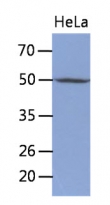
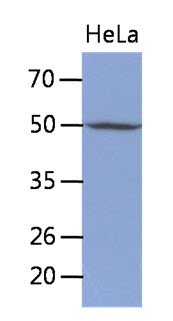
ARG57019 anti-Thymine DNA glycosylase antibody [2F7] WB image
Western blot: 30 µg of HeLa cell lysate stained with ARG57019 anti-Thymine DNA glycosylase antibody [2F7] at 1:250.