ARG57490
anti-XPNPEP1 antibody [9C7]
anti-XPNPEP1 antibody [9C7] for Western blot and Human
Overview
| Product Description | Mouse Monoclonal antibody [9C7] recognizes XPNPEP1 |
|---|---|
| Tested Reactivity | Hu |
| Tested Application | WB |
| Host | Mouse |
| Clonality | Monoclonal |
| Clone | 9C7 |
| Isotype | IgG2b, kappa |
| Target Name | XPNPEP1 |
| Antigen Species | Human |
| Immunogen | Recombinant Human XPNPEP1 (aa. 1-623) purified from E. coli. |
| Conjugation | Un-conjugated |
| Alternate Names | XPNPEPL; Soluble aminopeptidase P; EC 3.4.11.9; sAmp; XPNPEPL1; Cytosolic aminopeptidase P; Xaa-Pro aminopeptidase 1; APP1; Aminoacylproline aminopeptidase; X-Pro aminopeptidase 1; X-prolyl aminopeptidase 1, soluble; SAMP; XPNPEP |
Application Instructions
| Application Suggestion |
|
||||
|---|---|---|---|---|---|
| Application Note | * The dilutions indicate recommended starting dilutions and the optimal dilutions or concentrations should be determined by the scientist. |
Properties
| Form | Liquid |
|---|---|
| Purification | Purification with Protein A. |
| Buffer | PBS (pH 7.4), 0.02% Sodium azide and 10% Glycerol. |
| Preservative | 0.02% Sodium azide |
| Stabilizer | 10% Glycerol |
| Concentration | 1 mg/ml |
| Storage Instruction | For continuous use, store undiluted antibody at 2-8°C for up to a week. For long-term storage, aliquot and store at -20°C. Storage in frost free freezers is not recommended. Avoid repeated freeze/thaw cycles. Suggest spin the vial prior to opening. The antibody solution should be gently mixed before use. |
| Note | For laboratory research only, not for drug, diagnostic or other use. |
Bioinformation
| Database Links | |
|---|---|
| Gene Symbol | XPNPEP1 |
| Gene Full Name | X-prolyl aminopeptidase (aminopeptidase P) 1, soluble |
| Background | This gene encodes the cytosolic form of a metalloaminopeptidase that catalyzes the cleavage of the N-terminal amino acid adjacent to a proline residue. The gene product may play a role in degradation and maturation of tachykinins, neuropeptides, and peptide hormones. Alternative splicing results in multiple transcript variants.[provided by RefSeq, Nov 2009] |
| Function | Contributes to the degradation of bradykinin. Catalyzes the removal of a penultimate prolyl residue from the N-termini of peptides, such as Arg-Pro-Pro. [UniProt] |
| Calculated MW | 70 kDa |
Images (1) Click the Picture to Zoom In
-
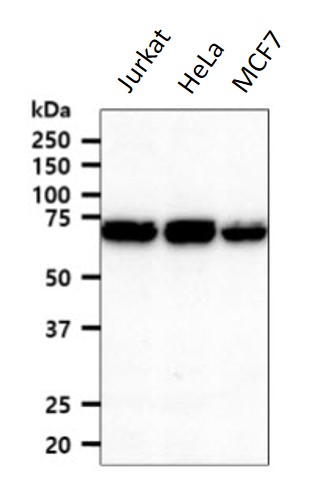
ARG57490 anti-XPNPEP1 antibody [9C7] WB image
Western blot: 40 µg of Jurkat, HeLa and MCF7 cell lysates stained with ARG57490 anti-XPNPEP1 antibody [9C7] at 1:1000 dilution.