Click to copy cat No.
ARG59150
Click to copy product name
anti-XRCC4 antibody
anti-XRCC4 antibody for ICC/IF,IHC-Formalin-fixed paraffin-embedded sections,Western blot and Human,Rat
Overview
| Product Description | Rabbit Polyclonal antibody recognizes XRCC4 |
|---|---|
| Tested Reactivity | Hu, Rat |
| Tested Application | ICC/IF, IHC-P, WB |
| Host | Rabbit |
| Clonality | Polyclonal |
| Isotype | IgG |
| Target Name | XRCC4 |
| Antigen Species | Human |
| Immunogen | Recombinant fusion protein corresponding to aa. 1-336 of Human XRCC4 (NP_071801.1). |
| Conjugation | Un-conjugated |
| Alternate Names | DNA repair protein XRCC4; SSMED; X-ray repair cross-complementing protein 4 |
Application Instructions
| Predict Reactivity Note | Mouse, Rat | ||||||||
|---|---|---|---|---|---|---|---|---|---|
| Application Suggestion |
|
||||||||
| Application Note | * The dilutions indicate recommended starting dilutions and the optimal dilutions or concentrations should be determined by the scientist. |
Properties
| Form | Liquid |
|---|---|
| Purification | Affinity purified. |
| Buffer | PBS (pH 7.3), 0.02% Sodium azide and 50% Glycerol. |
| Preservative | 0.02% Sodium azide |
| Stabilizer | 50% Glycerol |
| Storage Instruction | For continuous use, store undiluted antibody at 2-8°C for up to a week. For long-term storage, aliquot and store at -20°C. Storage in frost free freezers is not recommended. Avoid repeated freeze/thaw cycles. Suggest spin the vial prior to opening. The antibody solution should be gently mixed before use. |
| Note | For laboratory research only, not for drug, diagnostic or other use. |
Bioinformation
| Database Links | |
|---|---|
| Gene Symbol | XRCC4 |
| Gene Full Name | X-ray repair complementing defective repair in Chinese hamster cells 4 |
| Background | The protein encoded by this gene functions together with DNA ligase IV and the DNA-dependent protein kinase in the repair of DNA double-strand break by non-homologous end joining and the completion of V(D)J recombination events. The non-homologous end-joining pathway is required both for normal development and for suppression of tumors. This gene functionally complements XR-1 Chinese hamster ovary cell mutant, which is impaired in DNA double-strand breaks produced by ionizing radiation and restriction enzymes. Alternative transcription initiation and alternative splicing generates several transcript variants. [provided by RefSeq, Sep 2008] |
| Function | Involved in DNA non-homologous end joining (NHEJ) required for double-strand break repair and V(D)J recombination. Binds to DNA and to DNA ligase IV (LIG4). The LIG4-XRCC4 complex is responsible for the NHEJ ligation step, and XRCC4 enhances the joining activity of LIG4. Binding of the LIG4-XRCC4 complex to DNA ends is dependent on the assembly of the DNA-dependent protein kinase complex DNA-PK to these DNA ends. [UniProt] |
| Cellular Localization | Nucleus. [UniProt] |
| Calculated MW | 38 kDa |
| PTM | Phosphorylated by PRKDC. The phosphorylation seems not to be necessary for binding to DNA. Phosphorylation by CK2 promotes interaction with APTX. Monoubiquitinated. Sumoylation at Lys-210 is required for nuclear localization and recombination efficiency. Has no effect on ubiquitination. [UniProt] |
Images (2) Click the Picture to Zoom In
-
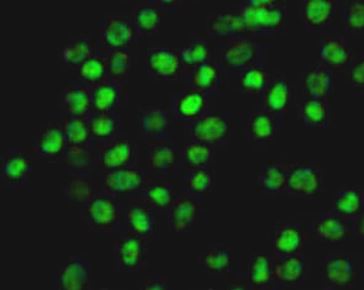
ARG59150 anti-XRCC4 antibody ICC/IF image
Immunofluorescence: 293T cells stained with ARG59150 anti-XRCC4 antibody at 1:100 dilution.
-
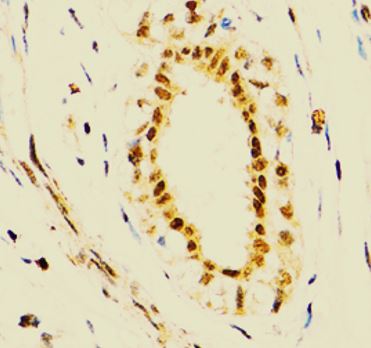
ARG59150 anti-XRCC4 antibody IHC-P image
Immunohistochemistry: Paraffin-embedded Human breast cancer stained with ARG59150 anti-XRCC4 antibody at 1:100 dilution.