ARG58146
anti-alpha + beta Synuclein antibody
anti-alpha + beta Synuclein antibody for Flow cytometry,ICC/IF,Western blot and Human,Mouse,Rat
Overview
| Product Description | Rabbit Polyclonal antibody recognizes alpha + beta Synuclein |
|---|---|
| Tested Reactivity | Hu, Ms, Rat |
| Tested Application | FACS, ICC/IF, WB |
| Host | Rabbit |
| Clonality | Polyclonal |
| Isotype | IgG |
| Target Name | alpha + beta Synuclein |
| Antigen Species | Human |
| Immunogen | Synthetic peptide derived from Human alpha+beta Synuclein. |
| Conjugation | Un-conjugated |
| Alternate Names | Non-A4 component of amyloid precursor; Alpha-synuclein; PARK4; PARK1; PD1; NACP; Non-A beta component of AD amyloid |
Application Instructions
| Application Suggestion |
|
||||||||
|---|---|---|---|---|---|---|---|---|---|
| Application Note | * The dilutions indicate recommended starting dilutions and the optimal dilutions or concentrations should be determined by the scientist. | ||||||||
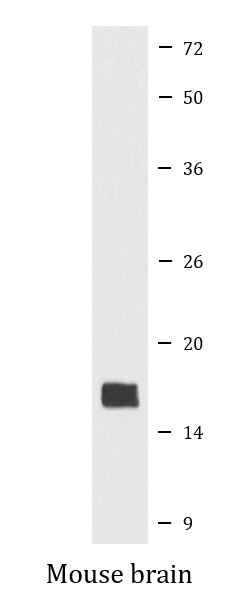
| Positive Control | Mouse brain | ||||||||
| Observed Size | ~ 16 kDa |
Properties
| Form | Liquid |
|---|---|
| Purification | Affinity purified. |
| Buffer | PBS (pH 7.4), 0.02% Sodium azide and 50% Glycerol. |
| Preservative | 0.02% Sodium azide |
| Stabilizer | 50% Glycerol |
| Storage Instruction | For continuous use, store undiluted antibody at 2-8°C for up to a week. For long-term storage, aliquot and store at -20°C. Storage in frost free freezers is not recommended. Avoid repeated freeze/thaw cycles. Suggest spin the vial prior to opening. The antibody solution should be gently mixed before use. |
| Note | For laboratory research only, not for drug, diagnostic or other use. |
Bioinformation
| Database Links | |
|---|---|
| Gene Symbol | SNCA |
| Gene Full Name | synuclein, alpha (non A4 component of amyloid precursor) |
| Background | Alpha-synuclein is a member of the synuclein family, which also includes beta- and gamma-synuclein. Synucleins are abundantly expressed in the brain and alpha- and beta-synuclein inhibit phospholipase D2 selectively. SNCA may serve to integrate presynaptic signaling and membrane trafficking. Defects in SNCA have been implicated in the pathogenesis of Parkinson disease. SNCA peptides are a major component of amyloid plaques in the brains of patients with Alzheimer's disease. Four alternatively spliced transcripts encoding two different isoforms have been identified for this gene. [provided by RefSeq, Mar 2009] |
| Function | May be involved in the regulation of dopamine release and transport. Induces fibrillization of microtubule-associated protein tau. Reduces neuronal responsiveness to various apoptotic stimuli, leading to a decreased caspase-3 activation. [UniProt] |
| Cellular Localization | Secreted. [UniProt] |
| Calculated MW | 14 kDa |
| PTM | Phosphorylated, predominantly on serine residues. Phosphorylation by CK1 appears to occur on residues distinct from the residue phosphorylated by other kinases. Phosphorylation of Ser-129 is selective and extensive in synucleinopathy lesions. In vitro, phosphorylation at Ser-129 promoted insoluble fibril formation. Phosphorylated on Tyr-125 by a PTK2B-dependent pathway upon osmotic stress. Hallmark lesions of neurodegenerative synucleinopathies contain alpha-synuclein that is modified by nitration of tyrosine residues and possibly by dityrosine cross-linking to generated stable oligomers. Ubiquitinated. The predominant conjugate is the diubiquitinated form (By similarity). Acetylation at Met-1 seems to be important for proper folding and native oligomeric structure. [UniProt] |
Images (1) Click the Picture to Zoom In
-
ARG58146 anti-alpha + beta Synuclein antibody WB image
Western blot: Mouse brain tissue lysate stained with ARG58146 anti-alpha + beta Synuclein antibody.