ARG51524
anti-c-Rel phospho (Ser503) antibody
anti-c-Rel phospho (Ser503) antibody for ICC/IF and Human
Cancer antibody; Gene Regulation antibody; Signaling Transduction antibody
Overview
| Product Description | Rabbit Polyclonal antibody recognizes c-Rel phospho (Ser503) |
|---|---|
| Tested Reactivity | Hu |
| Tested Application | ICC/IF |
| Host | Rabbit |
| Clonality | Polyclonal |
| Isotype | IgG |
| Target Name | c-Rel |
| Antigen Species | Human |
| Immunogen | Peptide sequence around phosphorylation site of serine 503 (T-S-S(p)-D-S) derived from Human c-Rel. |
| Conjugation | Un-conjugated |
| Alternate Names | Proto-oncogene c-Rel; C-Rel |
Application Instructions
| Application Suggestion |
|
||||
|---|---|---|---|---|---|
| Application Note | * The dilutions indicate recommended starting dilutions and the optimal dilutions or concentrations should be determined by the scientist. |
Properties
| Form | Liquid |
|---|---|
| Purification | Antibodies were produced by immunizing rabbits with KLH-conjugated synthetic phosphopeptide. Antibodies were purified by affinity-chromatography using epitope-specific phosphopeptide. In addition, non-phospho specific antibodies were removed by chromatogramphy using non-phosphopeptide. |
| Buffer | PBS (without Mg2+ and Ca2+, pH 7.4), 150mM NaCl, 0.02% Sodium azide and 50% Glycerol. |
| Preservative | 0.02% Sodium azide |
| Stabilizer | 50% Glycerol |
| Concentration | 1 mg/ml |
| Storage Instruction | For continuous use, store undiluted antibody at 2-8°C for up to a week. For long-term storage, aliquot and store at -20°C. Storage in frost free freezers is not recommended. Avoid repeated freeze/thaw cycles. Suggest spin the vial prior to opening. The antibody solution should be gently mixed before use. |
| Note | For laboratory research only, not for drug, diagnostic or other use. |
Bioinformation
| Database Links | |
|---|---|
| Gene Symbol | REL |
| Gene Full Name | v-rel avian reticuloendotheliosis viral oncogene homolog |
| Background | The REL gene encodes c-Rel, a transcription factor that is a member of the Rel/NFKB family, which also includes RELA (MIM 164014), RELB (604758), NFKB1 (MIM 164011), and NFKB2 (MIM 164012). These proteins are related through a highly conserved N-terminal region termed the 'Rel domain,' which is responsible for DNA binding, dimerization, nuclear localization, and binding to the NFKB inhibitor (MIM 164008) (Belguise and Sonenshein, 2007 (PubMed 18037997)). |
| Function | Proto-oncogene that may play a role in differentiation and lymphopoiesis. NF-kappa-B is a pleiotropic transcription factor which is present in almost all cell types and is involved in many biological processed such as inflammation, immunity, differentiation, cell growth, tumorigenesis and apoptosis. NF-kappa-B is a homo- or heterodimeric complex formed by the Rel-like domain-containing proteins RELA/p65, RELB, NFKB1/p105, NFKB1/p50, REL and NFKB2/p52. The dimers bind at kappa-B sites in the DNA of their target genes and the individual dimers have distinct preferences for different kappa-B sites that they can bind with distinguishable affinity and specificity. Different dimer combinations act as transcriptional activators or repressors, respectively. NF-kappa-B is controlled by various mechanisms of post-translational modification and subcellular compartmentalization as well as by interactions with other cofactors or corepressors. NF-kappa-B complexes are held in the cytoplasm in an inactive state complexed with members of the NF-kappa-B inhibitor (I-kappa-B) family. In a conventional activation pathway, I-kappa-B is phosphorylated by I-kappa-B kinases (IKKs) in response to different activators, subsequently degraded thus liberating the active NF-kappa-B complex which translocates to the nucleus. The NF-kappa-B heterodimer RELA/p65-c-Rel is a transcriptional activator. [UniProt] |
| Research Area | Cancer antibody; Gene Regulation antibody; Signaling Transduction antibody |
| Calculated MW | 69 kDa |
Images (1) Click the Picture to Zoom In
-
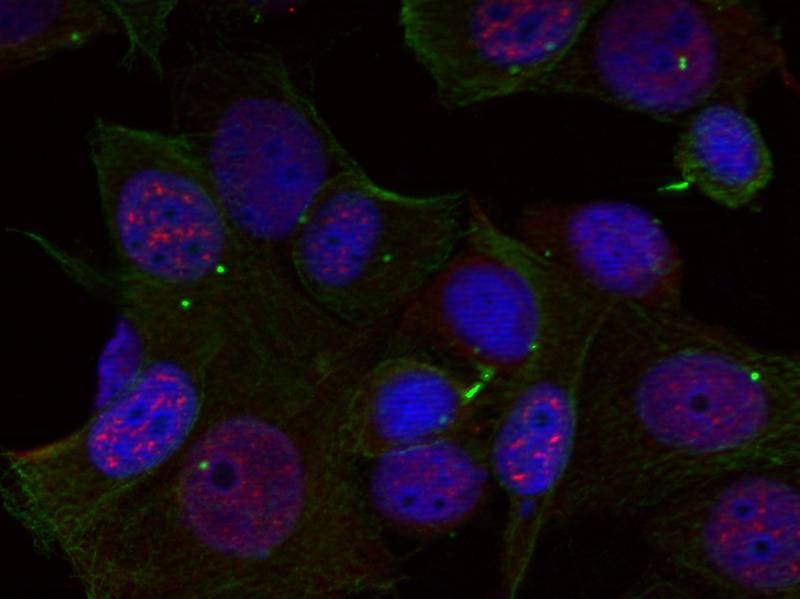
ARG51524 anti-c-Rel phospho (Ser503) antibody ICC/IF image
Immunofluorescence: methanol-fixed HeLa cells stained with ARG51524 anti-c-Rel phospho (Ser503) antibody.