Click to copy cat No.
ARG57311
Click to copy product name
anti-CD151 antibody
anti-CD151 antibody for IHC-Formalin-fixed paraffin-embedded sections,Western blot and Human,Mouse,Rat
Overview
| Product Description | Rabbit Polyclonal antibody recognizes CD151 |
|---|---|
| Tested Reactivity | Hu, Ms, Rat |
| Tested Application | IHC-P, WB |
| Host | Rabbit |
| Clonality | Polyclonal |
| Isotype | IgG |
| Target Name | CD151 |
| Antigen Species | Human |
| Immunogen | Recombinant Protein of Human CD151. |
| Conjugation | Un-conjugated |
| Alternate Names | SFA1; Tetraspanin-24; GP27; Tspan-24; MER2; TSPAN24; PETA-3; RAPH; Membrane glycoprotein SFA-1; CD151 antigen; CD antigen CD151; Platelet-endothelial tetraspan antigen 3 |
Application Instructions
| Application Suggestion |
|
||||||
|---|---|---|---|---|---|---|---|
| Application Note | * The dilutions indicate recommended starting dilutions and the optimal dilutions or concentrations should be determined by the scientist. | ||||||
| Positive Control | Mouse kidney |
Properties
| Form | Liquid |
|---|---|
| Purification | Affinity purification with immunogen. |
| Buffer | PBS (pH 7.3), 0.02% Sodium azide and 50% Glycerol. |
| Preservative | 0.02% Sodium azide |
| Stabilizer | 50% Glycerol |
| Storage Instruction | For continuous use, store undiluted antibody at 2-8°C for up to a week. For long-term storage, aliquot and store at -20°C. Storage in frost free freezers is not recommended. Avoid repeated freeze/thaw cycles. Suggest spin the vial prior to opening. The antibody solution should be gently mixed before use. |
| Note | For laboratory research only, not for drug, diagnostic or other use. |
Bioinformation
| Database Links | |
|---|---|
| Gene Symbol | CD151 |
| Gene Full Name | CD151 molecule (Raph blood group) |
| Background | The protein encoded by this gene is a member of the transmembrane 4 superfamily, also known as the tetraspanin family. Most of these members are cell-surface proteins that are characterized by the presence of four hydrophobic domains. The proteins mediate signal transduction events that play a role in the regulation of cell development, activation, growth and motility. This encoded protein is a cell surface glycoprotein that is known to complex with integrins and other transmembrane 4 superfamily proteins. It is involved in cellular processes including cell adhesion and may regulate integrin trafficking and/or function. This protein enhances cell motility, invasion and metastasis of cancer cells. Multiple alternatively spliced transcript variants that encode the same protein have been described for this gene. [provided by RefSeq, Jul 2008] |
| Function | Essential for the proper assembly of the glomerular and tubular basement membranes in kidney. [UniProt] |
| Calculated MW | 28 kDa |
Images (2) Click the Picture to Zoom In
-
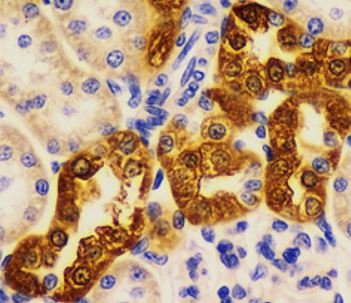
ARG57311 anti-CD151 antibody IHC-P image
Immunohistochemistry: Paraffin-embedded Rat kidney stained with ARG57311 anti-CD151 antibody at 1:200 dilution.
-
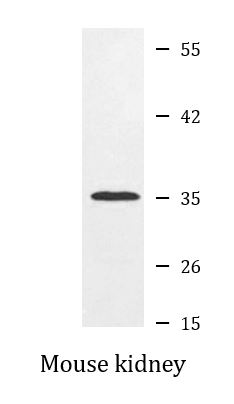
ARG57311 anti-CD151 antibody WB image
Western blot: Mouse kidney lysate stained with ARG57311 anti-CD151 antibody.