Click to copy cat No.
ARG40797
Click to copy product name
anti-GDF9 antibody
anti-GDF9 antibody for Western blot and Human,Mouse,Rat
 Publication1
Overview
| Product Description | Rabbit Polyclonal antibody recognizes GDF9 |
|---|---|
| Tested Reactivity | Hu, Ms, Rat |
| Tested Application | WB |
| Host | Rabbit |
| Clonality | Polyclonal |
| Isotype | IgG |
| Target Name | GDF9 |
| Antigen Species | Human |
| Immunogen | Recombinant fusion protein corresponding to aa. 205-454 of Human GDF9 (NP_005251.1). |
| Conjugation | Un-conjugated |
| Alternate Names | GDF-9; Growth/differentiation factor 9 |
Application Instructions
| Application Suggestion |
|
||||
|---|---|---|---|---|---|
| Application Note | * The dilutions indicate recommended starting dilutions and the optimal dilutions or concentrations should be determined by the scientist. | ||||
| Positive Control | 293T | ||||
| Observed Size | 50 kDa |
Properties
| Form | Liquid |
|---|---|
| Purification | Affinity purified. |
| Buffer | PBS (pH 7.3), 0.02% Sodium azide and 50% Glycerol. |
| Preservative | 0.02% Sodium azide |
| Stabilizer | 50% Glycerol |
| Storage Instruction | For continuous use, store undiluted antibody at 2-8°C for up to a week. For long-term storage, aliquot and store at -20°C. Storage in frost free freezers is not recommended. Avoid repeated freeze/thaw cycles. Suggest spin the vial prior to opening. The antibody solution should be gently mixed before use. |
| Note | For laboratory research only, not for drug, diagnostic or other use. |
Bioinformation
| Database Links | |
|---|---|
| Gene Symbol | GDF9 |
| Gene Full Name | growth differentiation factor 9 |
| Background | This gene encodes a member of the transforming growth factor-beta superfamily. The encoded preproprotein is processed into a secreted factor that is required for ovarian folliculogenesis. Alternative splicing results in multiple transcript variants. [provided by RefSeq, Jan 2014] |
| Function | Required for ovarian folliculogenesis. Promotes primordial follicle development. Stimulates granulosa cell proliferation. Promotes cell transition from G0/G1 to S and G2/M phases, through an increase of CCND1 and CCNE1 expression, and RB1 phosphorylation. It regulates STAR expression and cAMP-dependent progesterone release in granulosa and thecal cells. Attenuates the suppressive effects of activin A on STAR expression and progesterone production by increasing the expression of inhibin B. It suppresses FST and FSTL3 production in granulosa-lutein cells. [UniProt] |
| Cellular Localization | Secreted. [UniProt] |
| Calculated MW | 51 kDa |
| PTM | Phosphorylated; phosphorylation is critical for GDF9 function. In vitro, can be phosphorylated by CK at Ser-325. [UniProt] |
Images (1) Click the Picture to Zoom In
-
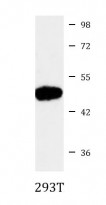
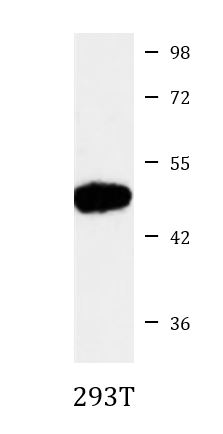
ARG40797 anti-GDF9 antibody WB image
Western blot: 25 µg of 293T cell lysate stained with ARG40797 anti-GDF9 antibody at 1:3000 dilution.
Specific References
Resveratrol improves ovarian state by inhibiting apoptosis of granulosa cells
WB / Human






